The Abrahamic Roots of Three Faiths
How Judaism, Christianity, and Islam trace themselves to Abraham
Judaism, Christianity, and Islam are often grouped together as the Abrahamic religions. The label points to a shared origin: all three trace their faith to Abraham, a figure each tradition regards as a patriarch and prophet who turned from the worship of many gods to the worship of one. Abraham appears in Jewish and Christian scripture, the Hebrew Bible, and in the Quran, the central scripture of Islam, as a common ancestor and an early holder of monotheism, the belief in a single God. Where the three traditions diverge is in what came after Abraham, and which of his descendants carries the line. Several of the places tied to those accounts are listed in this directory.
The Family at the Origin
According to Jewish and Christian tradition, Abraham's wife Sarah was unable to have children, and she gave her Egyptian servant Hagar to Abraham so that he might have a son. Hagar bore a son, Ishmael. Sarah later bore a son of her own, Isaac. After Isaac's birth, Sarah asked Abraham to send Hagar and Ishmael away.
Islamic tradition holds the same family but carries the line forward differently. It traces the Arab peoples, and the Prophet Muhammad, the seventh-century founder of Islam, to Abraham through Ishmael, while Jewish and Christian tradition carries the covenant through Isaac. Both the shared ancestry and the divergence between the traditions follow from this single point: the same household, with the line carried through two different sons.
The Binding of the Son
The point where the traditions hold the same event but set it on different ground is the near-sacrifice of Abraham's son. According to Jewish and Christian tradition, God commanded Abraham to offer his son as a sacrifice to test his faith, then stopped him at the last moment. A ram was offered in the son's place.
Jewish tradition names the son as Isaac and locates the event on Mount Moriah, which Jewish tradition identifies with the Temple Mount in Jerusalem. Christian tradition reads the near-sacrifice of Isaac as a foreshadowing of the death of Jesus. Islamic tradition holds that the son was Ishmael, and places the event not in Jerusalem but in the area of Mecca.
The Temple Mount in Jerusalem
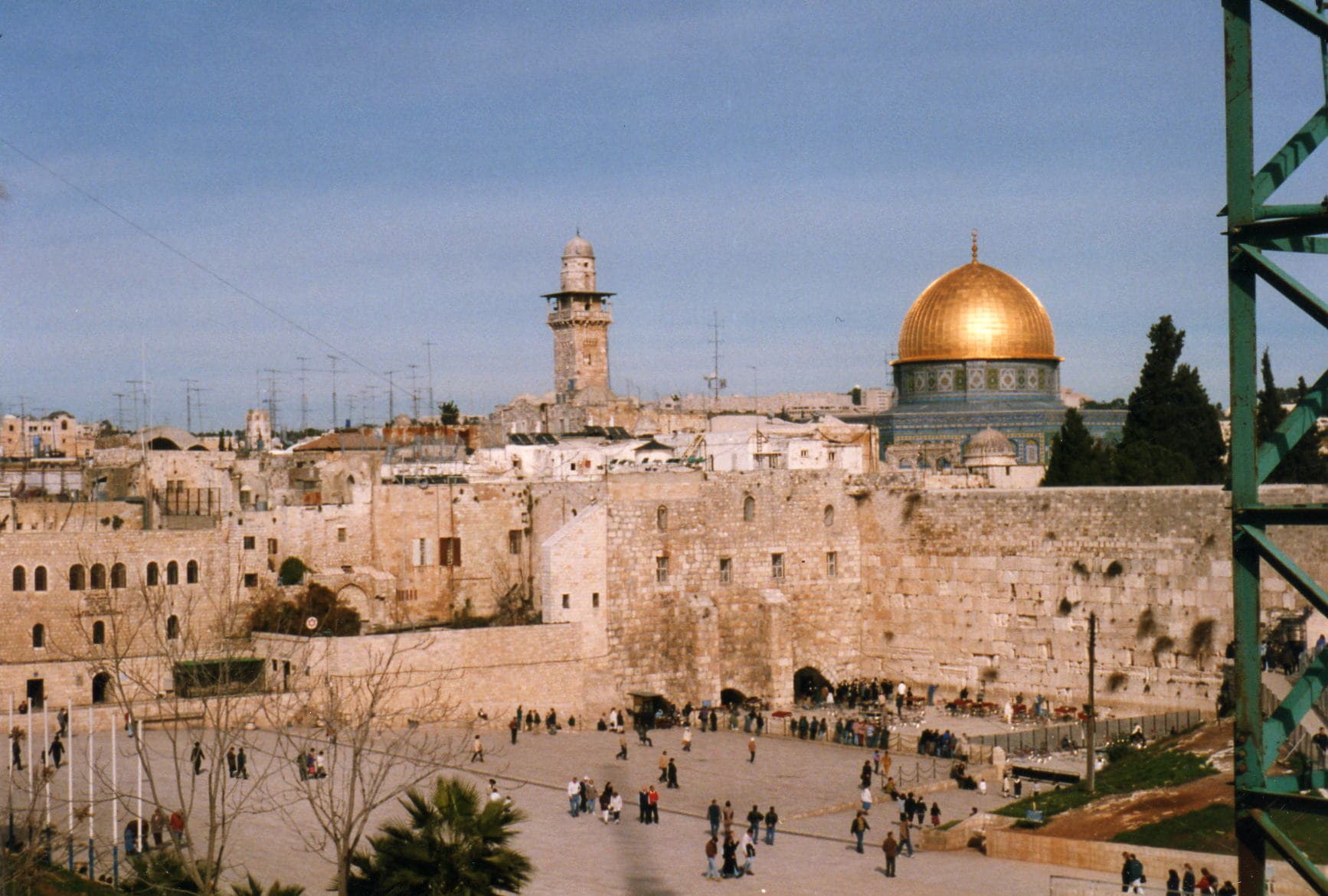
The raised platform in Jerusalem known as the Temple Mount, and to Muslims as Haram al-Sharif, the Noble Sanctuary, is venerated in all three traditions.
Judaism. Jewish tradition identifies the rock at its summit, the Foundation Stone, as the place of the binding of Isaac and as the site of the Holy of Holies, the innermost sanctuary of the Temple. A temple was built here in the first millennium BCE, associated in Jewish tradition with King Solomon, an early king of Israel. It was destroyed by the Babylonians in 586 BCE. The Second Temple that replaced it was destroyed by the Romans in 70 CE. The Temple Mount is the holiest site in Judaism. The Western Wall, a surviving section of the retaining wall of the Temple complex, is the focus of Jewish prayer.
Christianity. The Christian connection runs through Jesus, whom Christians believe to be the Son of God and the Messiah. Christian scripture describes Jesus teaching at the Temple that stood here. The site is not a primary place of worship for Christians today.
Islam. Muslims regard the compound as the third holiest site in Islam. It holds the Dome of the Rock, built over the Foundation Stone, and the Al-Aqsa Mosque. Islamic tradition holds that the Prophet Muhammad was carried from Mecca to Jerusalem in a single night, the Night Journey, and ascended to heaven from the rock.
The Cave of the Patriarchs in Hebron
The Cave of the Patriarchs, known to Muslims as the Sanctuary of Abraham and as the Ibrahimi Mosque, is located in Hebron, about thirty kilometers south of Jerusalem. According to Jewish and Christian scripture, Abraham purchased the cave of Machpelah to bury Sarah when she died, the first land the tradition records him owning in Canaan.
Jewish and Christian tradition holds that Abraham, Sarah, Isaac, Rebekah, Jacob, and Leah, the patriarchs and matriarchs, are buried there. The site is regarded as the holiest place in Judaism after the Temple Mount.
The site is venerated in Islam as the Mosque of Abraham (Ibrahim in Arabic) because Abraham is held to be the father of Ishmael and an ancestor through him. In the account shared by Jewish and Christian tradition, Abraham's two sons, Isaac and Ishmael, together buried their father here. The present structure is enclosed by walls built by Herod, the Roman-appointed king of Judea, about two thousand years ago.
Mecca
Mecca, in present-day Saudi Arabia, is the holiest city in Islam. It is the destination of the Hajj, the pilgrimage required once in a lifetime of every able Muslim. Its central sacred structures are tied to the same family.
Islamic tradition holds that Abraham, on God's command, brought Hagar and the infant Ishmael to the barren valley of Mecca and left them there. In the Islamic account, when their water ran out, Hagar ran seven times between two hills, Safa and Marwa, in search of it, and the well of Zamzam then sprang from the ground and saved them. The running is re-enacted by pilgrims in the rite of the Sa'i, the walking between Safa and Marwa, and pilgrims drink from Zamzam, which flows beside the Kaaba. Islamic tradition holds that Abraham and Ishmael together built the Kaaba, the cube-shaped structure Muslims face in prayer, as a house for the worship of one God. The willingness of Abraham to sacrifice his son, held in Islamic tradition to be Ishmael, is commemorated each year at Eid al-Adha, the festival of sacrifice. Through Ishmael, who Islamic tradition holds remained at Mecca, the line is traced to the Prophet Muhammad.
- → Temple Mount / Haram al-Sharif
- → Western Wall
- → Cave of the Patriarchs
- → The Hajj. A five-day pilgrimage to Mecca at the heart of Islam
- → Great Mosque of Mecca