
Ambubachi Mela
The festival of the Goddess at Kamakhya
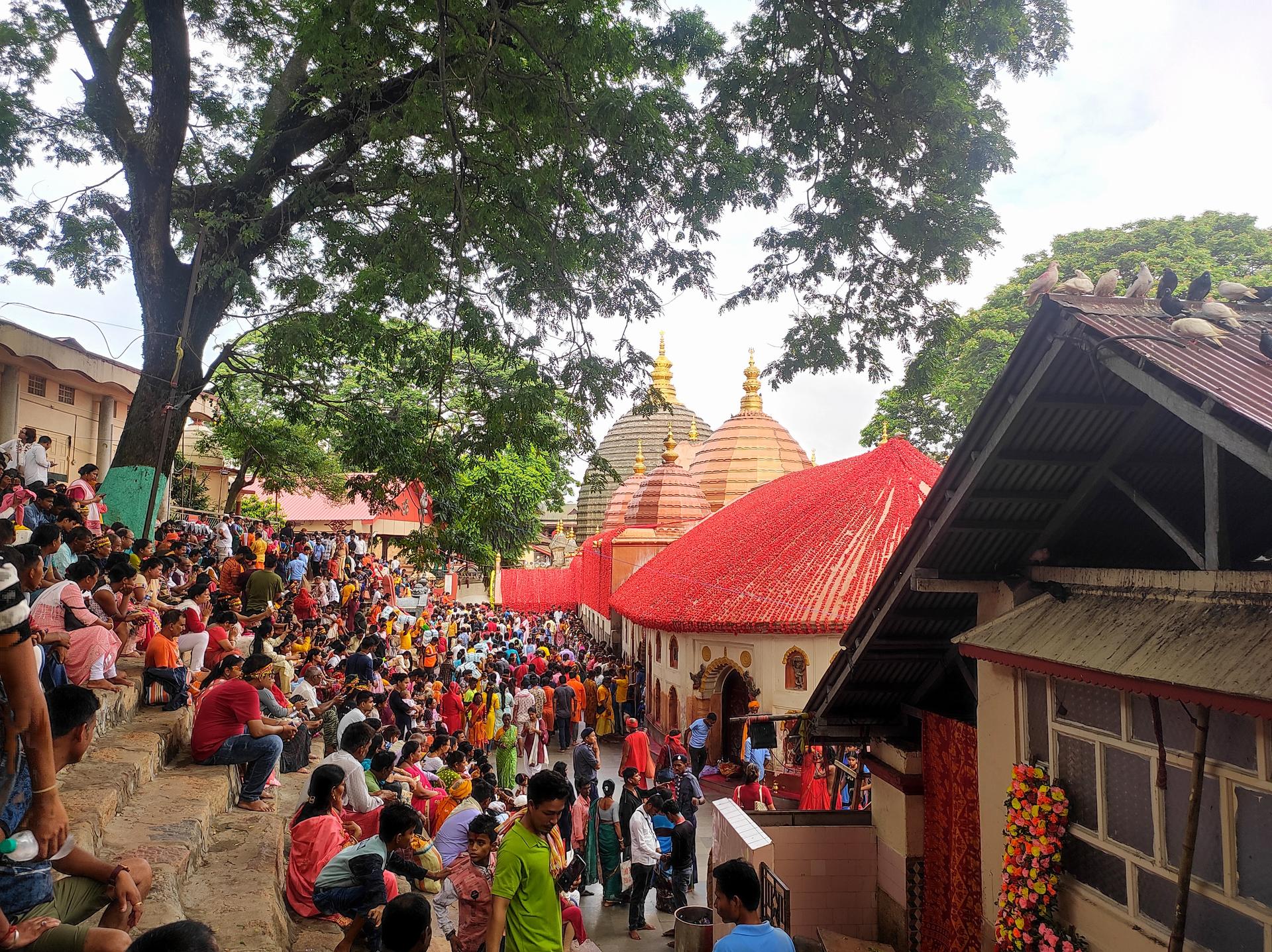
Ambubachi Mela is an annual Hindu festival at the Kamakhya Temple in Guwahati, in the state of Assam in northeastern India, at which devotees of the goddess Kamakhya, whom they worship as Mother Earth, celebrate her yearly menstruation as the sign of her divine power to create the universe and give birth to all life.
The festival begins around 22 June, at the start of the monsoon rains, when the first heavy rain soaks the fields before the rice is planted, marking the phase where the earth is fertile. During this time the Goddess is held to be resting during her period and must not be disturbed. Devotees believe that the goddess is renewing her creative energy. For three days the doors of the temple stay closed, while the devotees wait outside. On the morning of the fourth day the priests perform ceremonial cleansing and bathing, and open the doors of the temple. Pilgrims receive pieces of the red cloth that covered the Goddess, which they keep as her blessing. Ambubachi Mela draws hundreds of thousands of pilgrims to Guwahati each year. The name Ambubachi is commonly explained as the flowing of water, in reference to the rains.
The Goddess Kamakhya
The Kamakhya Temple is located on Nilachal Hill, the Blue Hill, above the Brahmaputra River in the west of Guwahati. It is the temple of the goddess Kamakhya. Hindus of the Shakta tradition, the branch of Hinduism that worships the Goddess, regard her as a form of Shakti, the divine power that creates and sustains the universe and gives birth to all life. Devotees worship a stone shaped as a yoni, the female organ of birth, as the source of all life.
According to Hindu tradition Shiva, one of the principal gods of Hinduism, had not been invited to a great sacrifice held by Daksha, the father of his wife Sati. Sati went to the sacrifice anyway. But she was humiliated there, and gave up her life in the sacrificial fire. In his grief Shiva carried her body across the worlds in a dance of destruction. To end his grief and save the world, the god Vishnu, the preserver of the universe among the principal gods of Hinduism, cut the body into pieces with his discus, and each piece fell to earth in a different place. These places are called Shakti Peethas, the seats of the Goddess, and Hindus regard them as places where her power is present in a special way. According to Hindu tradition, Sati's yoni fell on Nilachal Hill. Devotees therefore hold Kamakhya in particular reverence among the Shakti Peethas, as the seat of the Goddess in the form that gives life.
Kamakhya is also a center of Tantra, a Hindu ritual and meditation practice in which the Goddess is worshiped as the creative power of the universe and the body is regarded as a means of reaching the divine. Tantric practitioners come to the hill throughout the year.
The Meaning of the Festival
Hindu tradition in Assam holds that during Ambubachi the Goddess has her menstruation at the moment the monsoon makes the earth fertile again. The temple explains the festival from an old agricultural understanding in which the earth, soaked by the first rains and ready for the planting of rice, is compared to a woman able to bear children. The menstruation of the Goddess is therefore understood as a sign of her power to give life, and of the fertility of the earth from which the harvest will grow.
In the Shakta tradition understanding the Goddess rests during these days. The doors of the temple are closed so that she is not disturbed, and the daily worship inside the sanctum stops. Because the Goddess is also worshiped as the earth, the earth is held to be resting as well. Across Assam, no one digs, ploughs, sows, or plants the fields during the festival.
The Three Days of Closure
The festival begins at a moment set each year by the Hindu calendar, when the sun enters a particular position in the sky, around 21 or 22 June. At that moment the temple doors are closed. For three days no devotee enters the inner chamber, and no worship is held inside.
Pilgrims fill the slopes and the surrounding streets and wait for the reopening. Holy men and Tantric practitioners sit in meditation and chant outside the shrine, and devotees sing devotional songs through the night.
People across Assam mark the days in their homes as well. Widows, Brahmins (members of the Hindu priestly class), and celibate devotees eat no cooked food during these days. On the fourth day, household items, cooking pots, and clothes are washed and purified before ordinary life resumes.
The Reopening
On the morning of the fourth day the priests of the temple give the Goddess a ritual bath, which ends her days of rest, perform the daily worship again, and open the doors. Devotees crowd into the temple to see the Goddess again, in a darshan, the act of seeing and being seen by the deity, which Hindus regard as a blessing in itself.
Pilgrims then receive two blessed offerings, which Hindus understand as gifts the deity returns to her devotees. The first is water from the spring that keeps the stone in the sanctum moist. The second is a small piece of the red cloth that covered the stone, the Goddess in the form in which she is worshiped at Kamakhya, during the days of her menstruation. Devotees regard the cloth as carrying the power of the Goddess and keep it as a blessing.
The Festival and the Temple
Ambubachi is the principal festival of the Kamakhya Temple. Pilgrims come to Ambubachi from across India and from the neighboring countries of Nepal and Bangladesh. The temple is administered by the Bardeuri Samaj, the community of the hereditary priestly families of Kamakhya, who perform the rites of the closure and the reopening.