
The Feast of St. James
The feast of the apostle at Santiago de Compostela on 25 July
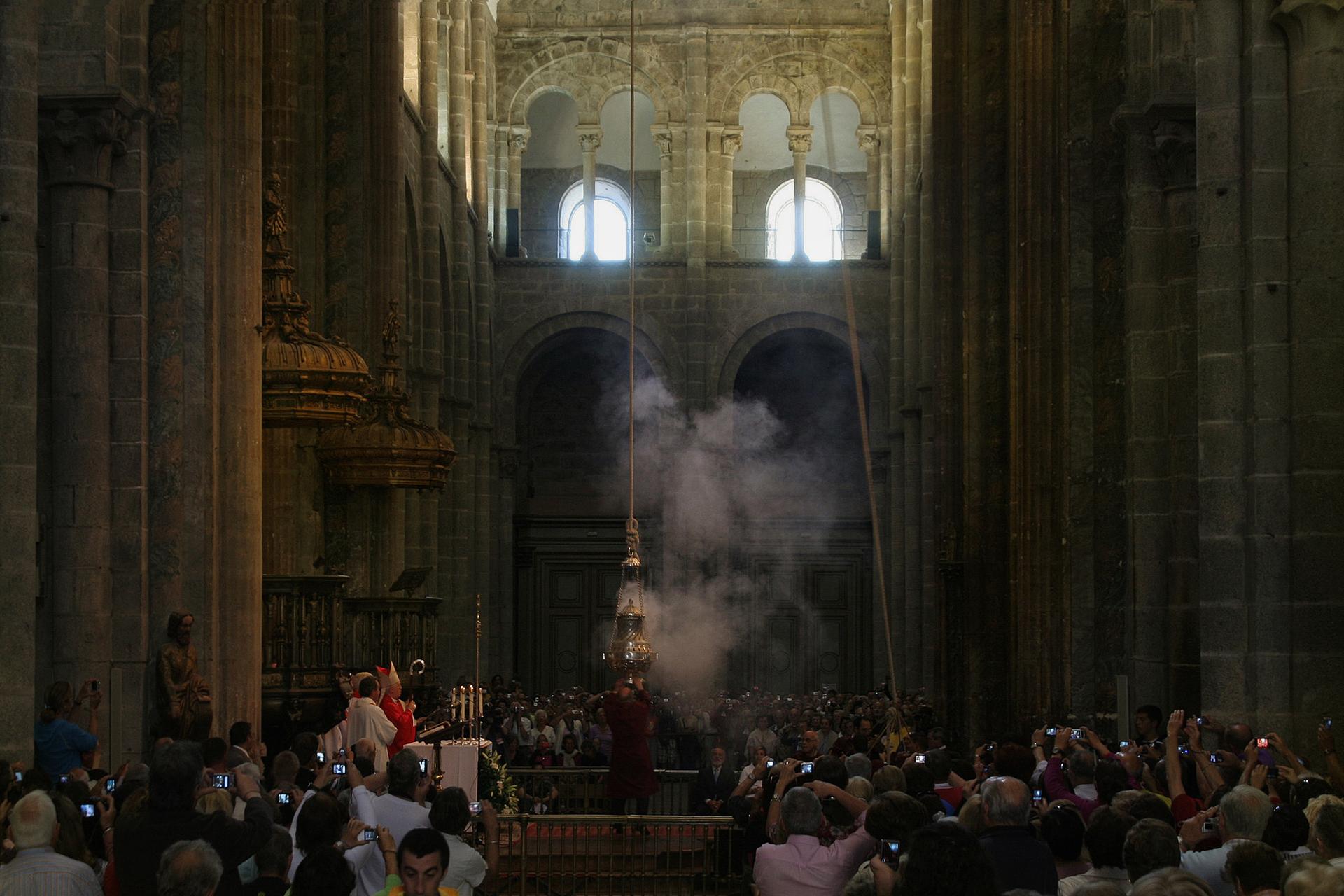
The Feast of St. James is the day on which the Catholic Church honors the apostle James the Greater, the patron saint of Spain, on 25 July each year with a special Mass, the central act of Catholic worship. James was one of the twelve closest followers of Jesus, whom Christians regard as the Son of God. Catholics venerate James as the apostle who first brought the Christian faith to Spain, and his feast is kept on the day on which the Church holds that he was killed for his faith. It is the principal feast of the year at Santiago de Compostela Cathedral in Galicia, in the northwest of Spain, which Catholics venerate as the place of his tomb. On the feast day the cathedral holds a solemn Mass at which an offering is made to the apostle in the name of the Spanish people, and the great censer of the cathedral, the Botafumeiro, is swung across the church. The evening before, the city celebrates with fireworks and music. The day is also the national day of Galicia. In a year in which 25 July falls on a Sunday, the cathedral celebrates a Holy Year, a year of forgiveness for the pilgrims who come to the tomb. Around the feast day the city holds a ten-day festival in the second half of July, the Festivals of the Apostle, with concerts, street theater and fireworks.
About St. James
Christian tradition holds that James was a fisherman from Galilee, the region around a lake in the north of present-day Israel where Jesus lived and preached. He was the son of Zebedee, a fisherman, and the brother of John, who is honored as another of the twelve apostles. According to Christian tradition Jesus called the two brothers from their father's boat to leave their nets and travel with him while he preached. Christian tradition holds that Jesus chose the apostles to carry his teaching into the world after his death, and that James, Peter, and John were the three apostles whom Jesus took with him at the decisive moments of his life. James is called James the Greater to distinguish him from a second apostle of the same name.
Christian tradition holds that King Herod Agrippa I, who ruled Judea, the Jewish homeland, under Roman rule, had James killed with the sword in Jerusalem around 44 CE. The Church honors James as the first of the twelve apostles to die as a martyr, a person killed for the faith. The Western Church celebrates his feast on 25 July as the day of his martyrdom, although the actual day of his death is not known. The Orthodox churches honor him on 30 April.
The Tomb of the Apostle
Christian tradition holds that James preached the Gospel, the Christian message, in Hispania, the Roman name for the Iberian Peninsula, before he returned to Jerusalem and was killed there. The Church in Santiago holds that after his death his disciples brought his body by boat across the Mediterranean to the coast of Galicia and buried it inland, and that the tomb was later forgotten.
According to the tradition of the cathedral, a hermit named Pelayo saw a star shining above a wood in the early ninth century and told the local bishop, Theodomir of Iria Flavia, who found the tomb there around 829. King Alfonso II of Asturias, the Christian kingdom in the north of Spain in whose territory the tomb lay, came to the site with his court and ordered a church to be built over it. The tradition of the cathedral regards him as the first pilgrim to the tomb. The city of Santiago de Compostela grew around the church, and from the ninth century pilgrims came from across Europe on the roads that became the Camino de Santiago. The present cathedral was consecrated in 1211.
Catholics regard James as the protector of Spain, and his tomb as the place where the apostle who brought the faith to the country rests among its people. For this reason the feast of the apostle is a feast of the Church in Spain as a whole, not of Santiago alone.
The Eve of the Feast
The celebration begins on the evening of 24 July. The city has marked this night with fire since at least the 16th century. In earlier centuries a wooden castle was built on the square in front of the cathedral, the Praza do Obradoiro, and set alight with rockets, and the people of the city called the eve the night of fire. From the late 19th century a painted wooden façade took the place of the castle and was burned in the same way. For centuries the fireworks were set off directly against the stone front of the cathedral. Over the years the fireworks have been launched from several places around the city, and a show of light and images is projected onto the façade of the cathedral instead.
The Day of the Feast
The day begins with a ceremony on the square in front of the cathedral, where the archbishop of Santiago receives the representative of the King of Spain. At the same time a procession leaves the cathedral carrying a silver statue of the apostle from the 14th century, which holds relics of the saint, and enters again through the main portal to the music of shawms, old wind instruments that have accompanied the procession since the 16th century. The solemn Mass of the feast follows.
At the center of the Mass is the National Offering to the Apostle in the form of prayers on 25 July. King Philip IV of Spain established it in 1643 as a yearly gift to the apostle in the name of the whole kingdom. Today it is offered by the King of Spain or a representative of the royal house. The representative reads an invocation to the apostle, a prayer in which he presents the offering and asks the saint to protect the country, and the archbishop answers at once with a homily, the sermon of the Mass. The offering expresses that the country places itself under the protection of its patron saint.
At the end of the Mass the Botafumeiro is swung across the cathedral while the hymn to the apostle is sung. The Botafumeiro is a silver-plated censer, a vessel in which incense is burned, about one and a half meters tall and weighing 53 kilograms. Eight men pull the ropes that set it in motion, and it swings in a great arc across the transept, the crossing arm of the church, hanging from pulleys about 20 meters above the floor. In Catholic worship incense honors God and the altar, and its rising smoke stands for the prayers of the faithful rising to heaven.
During the feast and the days around it, pilgrims perform the two acts that mark every arrival at the tomb. They climb the steps behind the high altar to embrace a stone statue of the apostle from the 13th century, and they go down to the crypt below the altar, where the relics of the apostle, the remains of his body, are kept in a silver urn, to pray.
The Holy Year
When 25 July falls on a Sunday, the year is a Holy Year of Compostela, also called the Xacobeo. The pattern repeats at intervals of six, five, six and eleven years. The cathedral dates the Holy Year to Pope Callixtus II in 1122, and Pope Alexander III confirmed it in 1179. On 31 December of the previous year the archbishop opens the Holy Door, a door at the rear of the cathedral that is walled up in ordinary years. Catholics also call it the Door of Forgiveness. Christian tradition holds that Christ himself is the door through which the faithful come to God, and the Church presents the walk through the Holy Door as the pilgrim's step from sin into grace, the forgiveness that the Holy Year offers. The door stays open through the whole year so that every pilgrim who comes to the tomb can take that step.
In a Holy Year the Church grants a plenary indulgence to those who visit the tomb. In Catholic teaching a plenary indulgence is the full remission of the punishment still owed for sins that have already been forgiven. The conditions are to visit the cathedral and pray there, among other prayers for the intentions of the pope, to confess, and to receive communion. The cathedral states that the jubilee does not depend on walking: it can be gained by anyone who comes to the tomb by any means. The feast day of a Holy Year is the high point of the jubilee, and pilgrims arrive at Santiago in far larger numbers than in other years.
- → Santiago de Compostela Cathedral
- → The Camino de Santiago. The network of pilgrim roads across Europe
Additional Resources
- Pilgrimage, Cathedral of Santiago de Compostela
- Linda Kay Davidson and Maryjane Dunn (eds.), The Pilgrimage to Compostela in the Middle Ages: A Book of Essays (Routledge, 1996)