
Gion Matsuri
Kyoto's month-long festival of purification
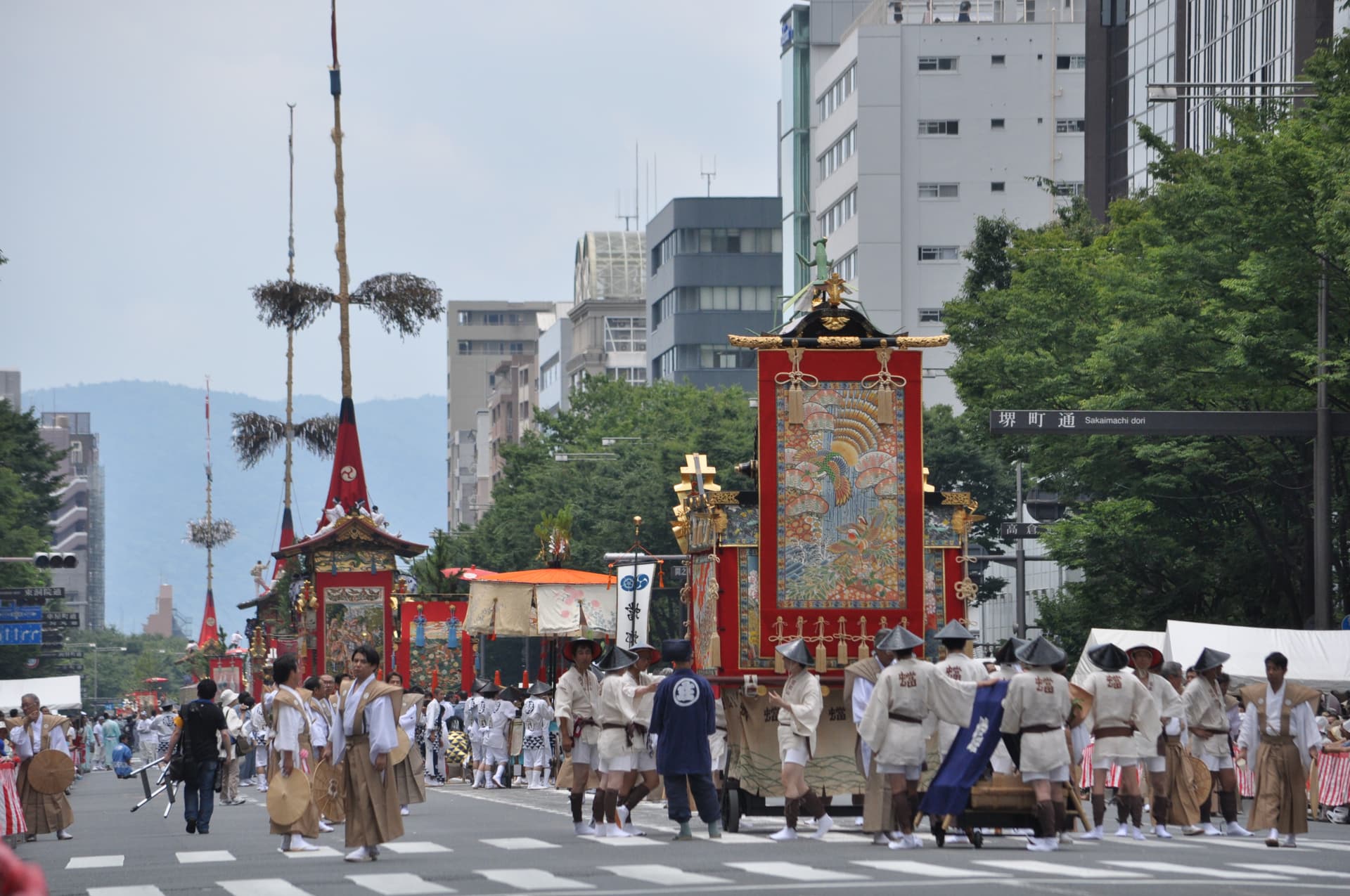
Gion Matsuri is the annual festival of Yasaka Shrine in Kyoto, Japan, held throughout the month of July. It is one of the largest and best-known festivals in Japan. The festival began more than 1,100 years ago as a ritual response to an epidemic, and its purpose within the Shinto tradition is purification and protection from disease and disaster. Its best-known events are two processions of large wooden floats through central Kyoto on 17 and 24 July.
The Origins of Gion Matsuri
In 869 CE, an epidemic swept through Kyoto, then the imperial capital of Japan. People at the time attributed the disease to angry spirits. Emperor Seiwa ordered a ritual called a Goryo-e, a ceremony to appease such spirits. Sixty-six halberds, tall spear-like poles, one for each of the provinces of Japan at the time, were erected at Shinsen-en, a garden near the imperial palace. Portable shrines from Yasaka Shrine were carried to the site. The ritual was repeated when later outbreaks occurred, and by the end of the 10th century it had become an annual event. Over the centuries, the halberds grew into the decorated Yamahoko floats paraded today.
The festival was interrupted in the late 15th century, when the Onin War, a civil war fought largely in Kyoto, devastated the city. Kyoto's merchant townspeople revived the festival in the 16th century, and the neighborhoods of central Kyoto have carried it ever since.
Yasaka Shrine
Yasaka Shrine is a Shinto shrine located in the Gion district of eastern Kyoto, at the end of Shijo Street. Shrine tradition dates its founding to 656 CE. The shrine enshrines Susanoo-no-Mikoto, the Shinto deity of storms, also revered for protection from calamity, together with his consort Kushinadahime and eight offspring deities.
For most of its history the shrine was known as Gion Shrine, and its deity was identified with Gozu Tenno, a protector deity against epidemics whose worship came to Japan through Buddhism. This reflected the long-standing merging of Buddhist and Shinto worship in Japan. In 1868, the Japanese government ordered the separation of Shinto and Buddhism, and the shrine was renamed Yasaka Shrine. The festival kept the old name of the district and the shrine.
The Yamahoko Floats
The festival's floats are collectively called Yamahoko. They are built, maintained, and paraded by the neighbourhood associations of central Kyoto, and each float belongs to a specific neighbourhood. There are two types. The Hoko are the large floats, recalling the halberds of the original ritual. A Hoko can reach roughly 25 meters in height and weigh several tons. It rolls on wooden wheels close to two meters across and is pulled through the streets on ropes by large teams. The Yama are smaller floats, most of them carried or drawn, bearing life-sized figures of deities and historical and legendary figures. More than thirty floats take part in the processions.
The floats are assembled each year in the days before the processions, built from timber bound with rope, without nails. They are decorated with textiles, including weavings from Kyoto's Nishijin textile district and tapestries imported over the centuries from Asia and Europe. Musicians ride on the larger floats, playing flutes, drums, and bells. Each year in early July, a lottery held at Kyoto's city hall sets the order in which the floats will parade.
During the festival, the neighborhoods sell Chimaki, protective amulets made of bamboo leaves, which residents display at their doorways through the year. The amulets are connected to an account that shrine tradition tells of Susanoo-no-Mikoto: traveling in disguise as a poor traveler, the deity was received hospitably by a man named Somin Shorai, and in gratitude promised to protect his descendants from epidemics.
The Processions
The two float processions, each called a Yamahoko Junko, take place on the mornings of 17 July and 24 July. The first, the Saki Matsuri, is the larger. The second, the Ato Matsuri, follows a reversed route a week later. The floats proceed slowly through the streets of central Kyoto. Turning a float at an intersection requires sliding the wheels across wet bamboo laid on the road, and these turns draw the largest crowds. A Chigo, a young boy chosen as a sacred messenger, rides the lead float of the first procession. By tradition, from 13 July until the procession ends he does not touch the ground, and he is carried wherever he goes.
Within the Shinto understanding of the festival, the float processions purify the streets ahead of the deities. The central religious events follow on the same evenings. On the evening of 17 July, in the Shinko-sai, the deities of Yasaka Shrine are transferred into three Mikoshi, portable shrines, and carried by teams of bearers through the neighborhoods of central Kyoto to the Otabisho, a temporary resting place, where they remain for a week. On the evening of 24 July, in the Kanko-sai, the Mikoshi are carried back to Yasaka Shrine. On the return, the procession stops at Shinsen-en, the garden where the first ritual was held in 869.
The Festival Through July
Gion Matsuri fills the entire month. It opens on 1 July with ceremonies at Yasaka Shrine and in the float neighborhoods, and the floats are built and tested in the days that follow. On the three evenings before each procession, known as the Yoiyama evenings, the streets around the floats close to traffic. The floats stand lit with paper lanterns, their musicians play, and residents of the old merchant houses open their street-facing rooms to display family heirlooms and folding screens, a custom known as the folding screen festival. These evenings draw large crowds from across Japan and abroad.
The festival closes on 31 July with a purification rite at the Eki Shrine, a small shrine within the grounds of Yasaka Shrine dedicated to protection from epidemics. Worshipers walk through a large ring of woven reeds, a Chinowa, as an act of purification, ending the month as it began, with a prayer for protection from disease.