
Navaratri
The Hindu nights of the Goddess
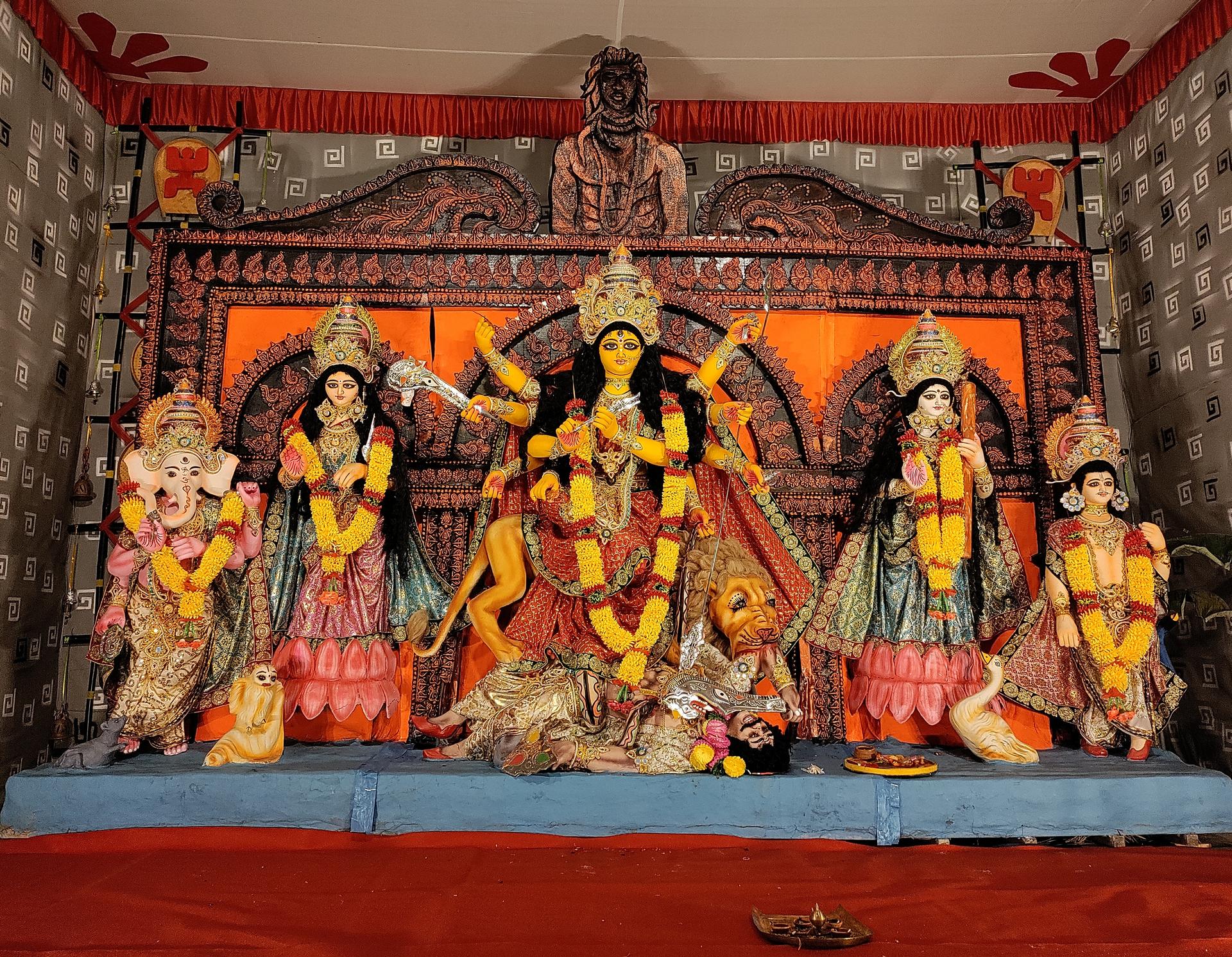
Navaratri ("nine nights") is a Hindu festival devoted to The Goddess, whom Hindus worship as the divine power that creates and sustains the universe, and above all to her form as Durga, the warrior goddess who defeats evil. The festival is celebrated across India and by Hindus around the world. In Bengal, in eastern India, it is celebrated as Durga Puja, the worship of Durga, in which clay images of the goddess are worshiped over the last five days and then immersed in the river. The principal Navaratri falls in the Hindu lunar month of Ashvin, in September or October. It begins on the first day after the new moon and ends on the tenth day, Vijayadashami, the day of victory, which is celebrated across North India as Dussehra. A second Navaratri is held in spring, in the month of Chaitra, in March or April. In both, Hindus worship the Goddess in her different forms, fast, pray, and gather for music and dance. One of the places where pilgrims gather in large numbers during the nine nights is the cave shrine of Vaishno Devi in the mountains of Jammu and Kashmir, in the north of India.
About Durga
Hindus worship the divine as feminine as well as masculine. The Goddess, called Devi, is regarded by her devotees as the power through which the universe is created and sustained, and she has many forms. Durga is one of her principal forms: a mother to her devotees and a warrior against evil. She is shown riding a lion, with many arms, each holding a weapon.
Hindu tradition tells of Mahishasura, a demon in the shape of a buffalo, who had won from the gods the promise that no man or god could defeat him. He drove the gods from heaven. The gods, led by Brahma, Vishnu, and Shiva, the three principal gods of Hinduism, who create, preserve, and destroy the universe, joined their powers into a single radiant figure, the goddess Durga, and each gave her a weapon. Because she was neither man nor god, the promise did not protect Mahishasura against her. Durga fought him for nine days and nights, while he changed his shape again and again, and on the tenth day she killed him in his buffalo form. The nine nights of the festival recall the nine nights of the battle, and the tenth day recalls the victory. Devotees celebrate the festival as the victory of good over evil.
In North India the tenth day carries a second meaning. There it marks the victory of Rama, a form of the god Vishnu and the hero of the Ramayana, one of the two great epics of Hinduism, over Ravana, the ten-headed demon king who had abducted Rama's wife Sita. This victory, too, is celebrated as the defeat of evil.
The Nine Nights
During Navaratri many Hindus fast, eating one meal a day or a simple vegetarian diet without onion or garlic, and pray to the Goddess in their homes and temples. Each of the nine nights is devoted to one of nine forms of Durga, worshiped in turn, from the daughter of the mountain on the first night to the giver of spiritual powers on the ninth. Devotees regard each form as a different aspect of the one Goddess.
On the eighth or ninth day, many families hold the worship of young girls. Nine girls who have not yet reached puberty are invited into the home. Their feet are washed, lamps are waved before them, and they are given food and gifts. Hindu tradition regards the girls as the nine forms of Durga in human form, so that honoring them is honoring the Goddess.
The festival takes a different form in each region. In Gujarat, in the west of India, people dance every night in circles around a lamp in a clay pot or an image of the Goddess, as an act of devotion to her. In North India, troupes perform the story of Rama as a play in episodes over the nine nights, and on Dussehra large effigies of Ravana filled with fireworks are burned, as a sign of the defeat of evil. In South India, families set out dolls and figures of the gods on stepped shelves in their homes and invite neighbors to see them.
Durga Puja in Bengal
In Bengal, and above all in the city of Kolkata, the festival is celebrated as Durga Puja, the worship of Durga. Bengali Hindu tradition holds that during these days Durga leaves her husband Shiva on Mount Kailash, the mountain in Tibet that Hindus regard as his home, and returns to the house of her parents on earth, together with her four children. The four are Lakshmi, the goddess of wealth; Saraswati, the goddess of learning; Ganesha, the elephant-headed god who removes obstacles; and Kartikeya, the god of war. The festival is therefore celebrated as a homecoming, the visit of a married daughter to her family, and the images show Durga with her children around her.
The images of Durga and her children are made each year from straw, bamboo, and unfired clay taken from the River Ganges, which Hindus revere as a sacred river. Many are made by hereditary families of image makers in a quarter of potters on the riverbank in North Kolkata. On the new moon before the festival the eyes are painted onto the images, and worship begins. The images are set up in pandals, temporary halls built of bamboo and cloth, in neighborhoods across the city, and Kolkata holds thousands of them. Each pandal is a shrine for the duration of the festival, and families walk from one to the next through the nights.
The main worship takes place over five days, from the sixth to the tenth day after the new moon. On the sixth day the Goddess is ritually awakened and invited to dwell in the image. The worship reaches its height at the moment when the eighth day turns into the ninth, when 108 lamps are lit before her. On the tenth day married women offer red vermilion powder to the image and then smear it on one another's faces, as a farewell to the Goddess before she leaves. The images are then carried in procession to the river and immersed in the water, which devotees understand as Durga's return to Shiva.
Navaratri at Vaishno Devi
Vaishno Devi is a cave shrine of the Goddess in the Trikuta mountains of Jammu and Kashmir, in the north of India, reached by a footpath of about twelve to thirteen kilometers from the town of Katra. Inside the cave there are no statues. The Goddess is worshiped in a natural rock with three heads, which devotees venerate as the presence of three goddesses in one: Mahakali, Mahalakshmi, and Mahasaraswati, the goddesses of power, prosperity, and knowledge. The shrine celebrates both Navaratris as festivals of the nine forms of the Goddess.
During both Navaratris the shrine is decorated with fresh flowers sent from across India and abroad, and devotional songs are sung on the way up the mountain. The shrine board, the public body that administers the shrine, holds a sacrifice of fire for nine days at the cave, in which offerings are poured into a sacred fire while hymns to the Goddess are recited, for peace and prosperity in the world. Large crowds of pilgrims climb to the cave through the nine nights, many of them fasting, greeting one another with the call of the pilgrims, victory to the Mother. The tradition of the shrine holds that the pilgrimage is complete only after a visit to the temple of Bhairon Nath above the cave, an ascetic who pursued the Goddess and whom she killed at the mouth of the cave and forgave as he died, granting that every pilgrim would visit him after visiting her. Pilgrims climb on to his temple after they have seen the Goddess.
Additional Resources
- Durga Puja in Kolkata, UNESCO Intangible Cultural Heritage
- Rachel Fell McDermott, Revelry, Rivalry, and Longing for the Goddesses of Bengal: The Fortunes of Hindu Festivals (Columbia University Press, 2011)