
The Rath Yatra
Puri's chariot festival of Jagannath
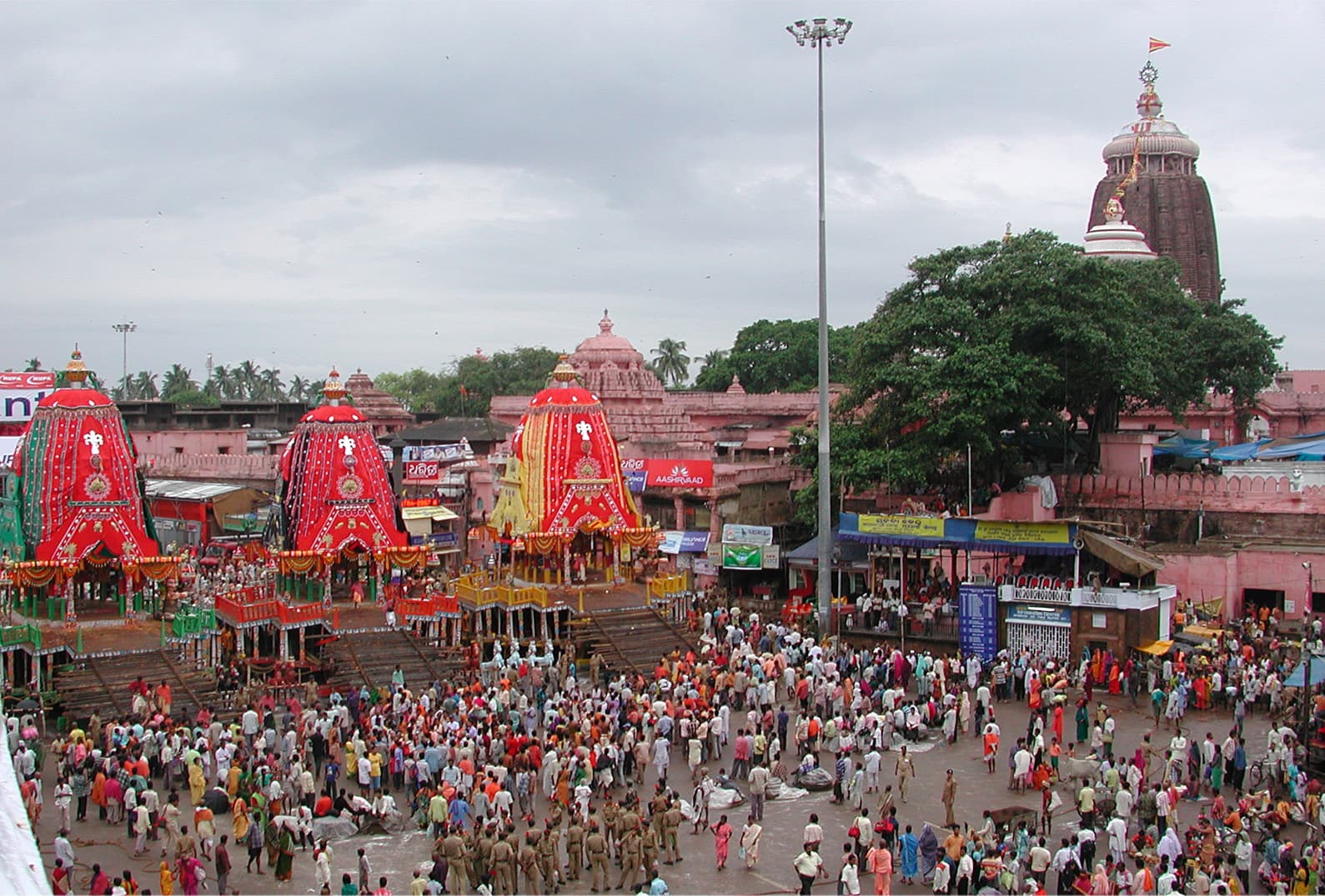
The Rath Yatra is the annual chariot festival of Puri, on the coast of Odisha in eastern India, in which the three deities of the Jagannath Temple, Puri, the god Jagannath, his elder brother Balabhadra, and his sister Subhadra, are taken out of their temple and pulled by crowds of devotees on three wooden chariots to a second temple about three kilometers away. The festival falls on the second day of the bright half of the lunar month of Ashadha, that is, the second day after the new moon, in the half of the month in which the moon grows, which comes in June or July. The deities stay at the second temple for about a week and return on the ninth day. The Rath Yatra draws pilgrims in the hundreds of thousands to Puri each year, and chariot processions modeled on it are held at Jagannath temples across India and around the world. The English word juggernaut, meaning an unstoppable force, comes from the name Jagannath and the sight of his chariot; standard dictionaries record this derivation.
About Jagannath
Jagannath means Lord of the Universe. Hindus worship him as a form of Vishnu, one of the principal gods of Hinduism, and many devotees regard him as Krishna, the form of Vishnu whose life is told in the Hindu epics. In Puri he is worshiped together with Balabhadra and Subhadra. Hindu tradition identifies Balabhadra with Balarama, Krishna's elder brother in the epics, and Subhadra with the sister of the two brothers. Their three images in the temple are venerated as a family. The three images are unlike most Hindu images. They are carved from neem wood, have large round eyes, and have no hands or feet. They are renewed in a rite held at intervals of about twelve to nineteen years, in which new images are carved and the sacred essence is transferred from the old to the new. Hindu tradition counts Puri as one of the four Char Dham, the four pilgrimage places at the corners of India, together with Badrinath, Dwarka, and Rameswaram, whose visit is held to lead toward liberation from the cycle of rebirth.
The Journey to the Gundicha Temple
The Rath Yatra takes the deities from the Jagannath Temple, Puri along the city's main avenue to the Gundicha Temple, a smaller temple at the far end of the avenue. Hindu tradition in Puri regards the Gundicha Temple as the place where the images were first carved, and devotees speak of the journey as the gods' visit to their birthplace, or to the house of their aunt. The road between the two temples, about three kilometers long and the width of a boulevard, is the stage of the festival.
Every year three new chariots are built for the journey, from timber brought to Puri in the spring by hereditary families of carpenters. The chariot of Jagannath is the largest of the three, with sixteen wheels, and is draped in red and yellow cloth. The chariots of Balabhadra and Subhadra are slightly smaller and draped in their own colors. Each is a tower of wood, several stories high, with a platform for the image and its attendants. After the festival the chariots are taken apart, and their timber is used for the temple kitchen fires and for other purposes.
The Rituals of the Festival
The festival is preceded by a bathing rite on the full moon of the previous month, in which the three images are carried onto a platform and bathed with more than a hundred pots of water. Hindu tradition holds that the gods fall ill with fever after the long bath, as a person would, and that they must rest and be treated. For about two weeks the images are therefore kept out of sight in a sealed room, where the temple's physician is held to treat them with herbal remedies and only the servants who care for them may enter. During this time the images are repainted, which the tradition understands as their recovery. They are shown again on the eve of the festival.
On the morning of the Rath Yatra the images are carried out of the temple one by one in a swaying procession and placed on their chariots. The hereditary king of Puri, the Gajapati, who has no political power but holds the first place among the temple's servants, then sweeps the platform of each chariot with a broom with a golden handle and sprinkles it with water and sandalwood. Hindu tradition holds that the king performs this service to show that before the god he is a sweeper like any other devotee. Only then are the ropes taken up.
The chariots are pulled by hand. Thousands of devotees take hold of the long ropes, and the chariots move in stages down the avenue, each stage announced by drums, cymbals, and conch shells. Pulling the ropes, or even touching them, is held to carry merit. The chariots usually reach the Gundicha Temple by evening, though a chariot that stalls may arrive the next day. The images are carried inside the next morning and stay for seven days, during which they are worshiped there and the main temple is left without its gods.
The Return
On the ninth day the chariots return by the same road to the Jagannath Temple, Puri. On the way back, tradition holds that Jagannath's wife, Lakshmi, who was left behind in the temple, closes the gate against him in anger, and a ritual exchange between the two is performed before he is let in. On the day after the return the three images are dressed in gold ornaments on their chariots, and crowds come to see them in this attire. Another day of ritual follows, and the images are carried back into the temple, where the daily cycle of worship resumes.
The Rath Yatra Beyond Puri
Chariot festivals of Jagannath are held on the same day at Jagannath temples across Odisha and India, and since the late twentieth century in cities around the world, where devotees pull decorated chariots through the streets of London, New York, Durban, and many other places. Hindu tradition holds that whoever sees Jagannath on his chariot is freed from the cycle of rebirth, and the festival is the one occasion on which the images leave the temple and are visible to everyone, including those who may not enter it.
Additional Resources
- Shree Jagannatha Temple Administration, official site
- J.C. Mahanti, The Saga of Jagannatha and Badadeula at Puri (Vij Books, 2014)