
The Hajj
The five-day pilgrimage to Mecca at the heart of Islam
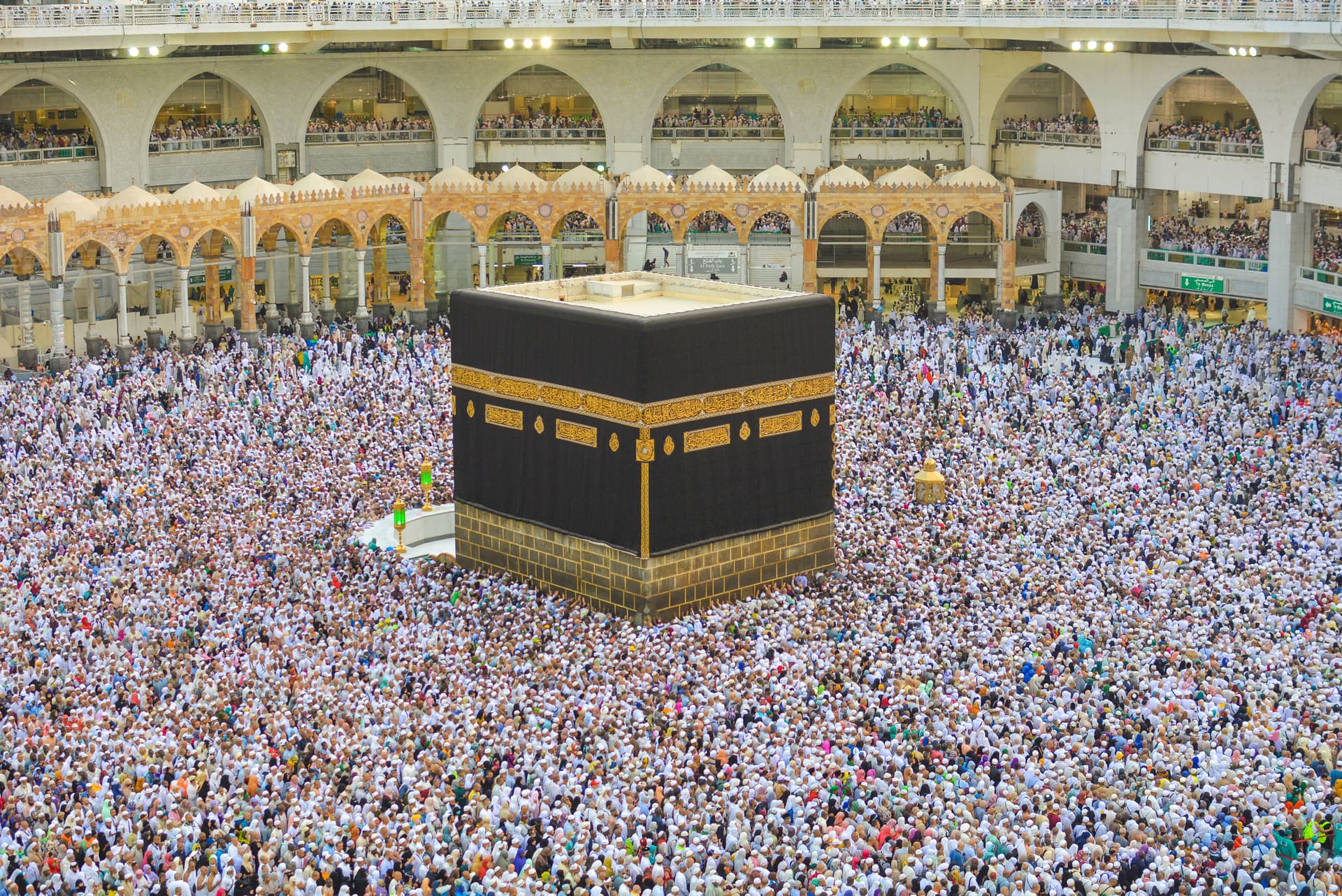
Each year, during the Islamic month of Dhul Hijjah, millions of Muslims travel to Mecca to perform the Hajj, the pilgrimage that Islam requires of every adult Muslim who is physically and financially able to make the journey at least once in a lifetime. Hajj is the fifth of the five pillars of Islam, alongside the declaration of faith, daily prayer, charity, and fasting during Ramadan. The rituals unfold over five to six days across a small stretch of western Saudi Arabia: Mecca itself, the valley of Mina, the plain of Arafat, and the open ground of Muzdalifah. Each stage carries specific meaning within Islamic tradition.
Ihram
Before entering Mecca, every pilgrim enters a state called Ihram. For men, this means removing all ordinary clothing and wearing two white unstitched cloths, one wrapped around the waist, one draped over the shoulder. Women wear clothing that covers everything except the face and hands. The uniform is meant to remove visible markers of wealth, status, and nationality. Islamic teaching holds that Ihram is a state of consecration in which the pilgrim sets aside worldly distinctions and stands before God as equal to every other pilgrim.
Ihram also includes a set of prohibitions that remain in effect for the duration of the pilgrimage: no perfume, no cutting of hair or nails, no intimate relations, no hunting, no arguing. The state begins at designated boundary points called Miqat, which surround Mecca at varying distances. Pilgrims crossing these boundaries declare their intention to perform and commit to the Hajj.
The Kaaba and Tawaf
At the center of the Grand Mosque (Masjid al-Haram) in Mecca stands the Kaaba, a cube-shaped stone structure roughly 13 meters high, 12 meters long, and 11 meters wide. It is draped in a black cloth called the Kiswah, embroidered with gold Quranic calligraphy. The Kiswah is replaced each year before Hajj.
Islamic tradition holds that the original structure was built by the Prophet Ibrahim (Abraham) and his son Ismail (Ishmael) as a house of worship dedicated to the one God. The Quran (the holy scripture of Islam) describes Ibrahim raising the foundations of the house and calling humanity to pilgrimage there. It functions as the Qibla, the direction all Muslims face during prayer, anywhere in the world. During Hajj, it is the focal point of the first major ritual: Tawaf.
Tawaf is the act of walking around the Kaaba seven times in a counterclockwise direction, as an act of worship.
The interior of the Kaaba is an empty room with a marble floor. The walls are covered with inscriptions and cloth hangings. It is opened only on rare occasions for ceremonial washing, performed twice a year by the custodians of the mosque.
The Black Stone
Set into the eastern corner of the Kaaba is the Black Stone (al-Hajar al-Aswad), a dark, fragmented stone approximately 30 centimeters in diameter, now held together by a silver frame. Each circuit of Tawaf begins and ends at this corner. Islamic tradition holds that the stone was sent down from paradise and handed to Ibrahim when he built the Kaaba.
The Prophet Muhammad is said to have kissed the stone during his pilgrimage, and pilgrims who can reach it kiss or touch it; others raise a hand toward it from a distance as they pass. These gestures are understood as following the Prophet's example, not as veneration of the stone itself.
Sa'i and the Well of Zamzam
After Tawaf, pilgrims perform Sa'i: walking seven times between two small hills, Safa and Marwa, now enclosed within the Grand Mosque complex. The distance between them is approximately 450 meters, making the full Sa'i about 3.15 kilometers.
The ritual reenacts an event from the life of Hajar (Hagar), the wife of Ibrahim. According to Islamic tradition, Ibrahim left Hajar and their infant son Ismail in the barren valley of Mecca at God's command. When their water ran out, Hajar ran between the two hills seven times, desperately searching for water or help. At the point of exhaustion, water sprang from the ground at Ismail's feet. This is said to be the origin of the Well of Zamzam, still active within the Grand Mosque compound. Pilgrims drink Zamzam water throughout their stay in Mecca. Islamic tradition holds that this well has been in continuous use for over four thousand years.
The Day of Arafat
On the 9th of Dhul Hijjah, pilgrims head to Arafat, a plain about 20 kilometers southeast of Mecca. The Day of Arafat is regarded as the central event of the Hajj. The Prophet Muhammad delivered his Farewell Sermon at Arafat in 632 CE, during his final pilgrimage. Pilgrims stand in prayer on the plain from noon until sunset, and some climb the small hill called Jabal al-Rahmah (Mountain of Mercy). Islamic tradition holds that this gathering prefigures the Day of Judgment, when all of humanity will stand before God.
Pilgrims are required not to miss the standing at Arafat, because it would mean not to have performed the Hajj at all.
After sunset, pilgrims continue to Muzdalifah, an open area between Arafat and Mina, to spend the night under the open sky, to pray, and to collect small pebbles for the next day's ritual.
The Stoning and the Sacrifice
On the 10th of Dhul Hijjah, the day of Eid al-Adha (the Festival of Sacrifice, celebrated by Muslims worldwide), pilgrims continue to Mina to commemorate an event from the life of Ibrahim that Islamic tradition recounts: when God commanded Ibrahim to sacrifice his son, the devil (Shaytan) appeared three times to tempt him to disobey. Ibrahim threw stones at the devil each time, rejecting the temptation. Three pillars mark this event. Pilgrims throw pebbles at the pillars to symbolically reject evil and temptation.
Also on this day, pilgrims participate in the sacrifice of an animal (typically a sheep or goat), in remembrance of Ibrahim's willingness to sacrifice his son before God provided a ram in his place. The meat is distributed to the poor.
After the sacrifice, pilgrims shave or trim their hair, which marks the beginning of their release from the state of Ihram.
Final Days
After the stoning at Mina, pilgrims return to Mecca to perform Tawaf al-Ifadah, a second circling of the Kaaba, which completes their release from the state of Ihram. Over the following two to three days, until the 12th or 13th of Dhul Hijjah, pilgrims move back and forth between Mecca and Mina to perform more stoning runs.
Before the pilgrims leave Mecca, they perform the farewell Tawaf (Tawaf al-Wada).
The Arc of Ibrahim's Life
According to Islamic tradition, the sequence of Hajj rituals traces the arc of Ibrahim's life: his building of the Kaaba, his wife Hajar's search for water, his willingness to sacrifice his son, and his rejection of the devil's temptation. The pilgrimage is understood within Islam as a physical reenactment of submission to God, the literal meaning of the word "Islam." Pilgrims return home having completed a fundamental obligation of their faith. Islamic tradition holds that a Hajj performed with sincerity and without wrongdoing returns the pilgrim to a state of spiritual purity.
Resources
- "Muslim Journeys | Item #164: 'Hajj' from Oxford Islamic Studies Online", April 10, 2026 http://bridgingcultures-muslimjourneys.org/items/show/164.
- F.E. Peters, The Hajj: The Muslim Pilgrimage to Mecca and the Holy Places (Princeton University Press, 1994)