
The Kandy Esala Perahera
Sri Lanka's procession of the Sacred Tooth Relic
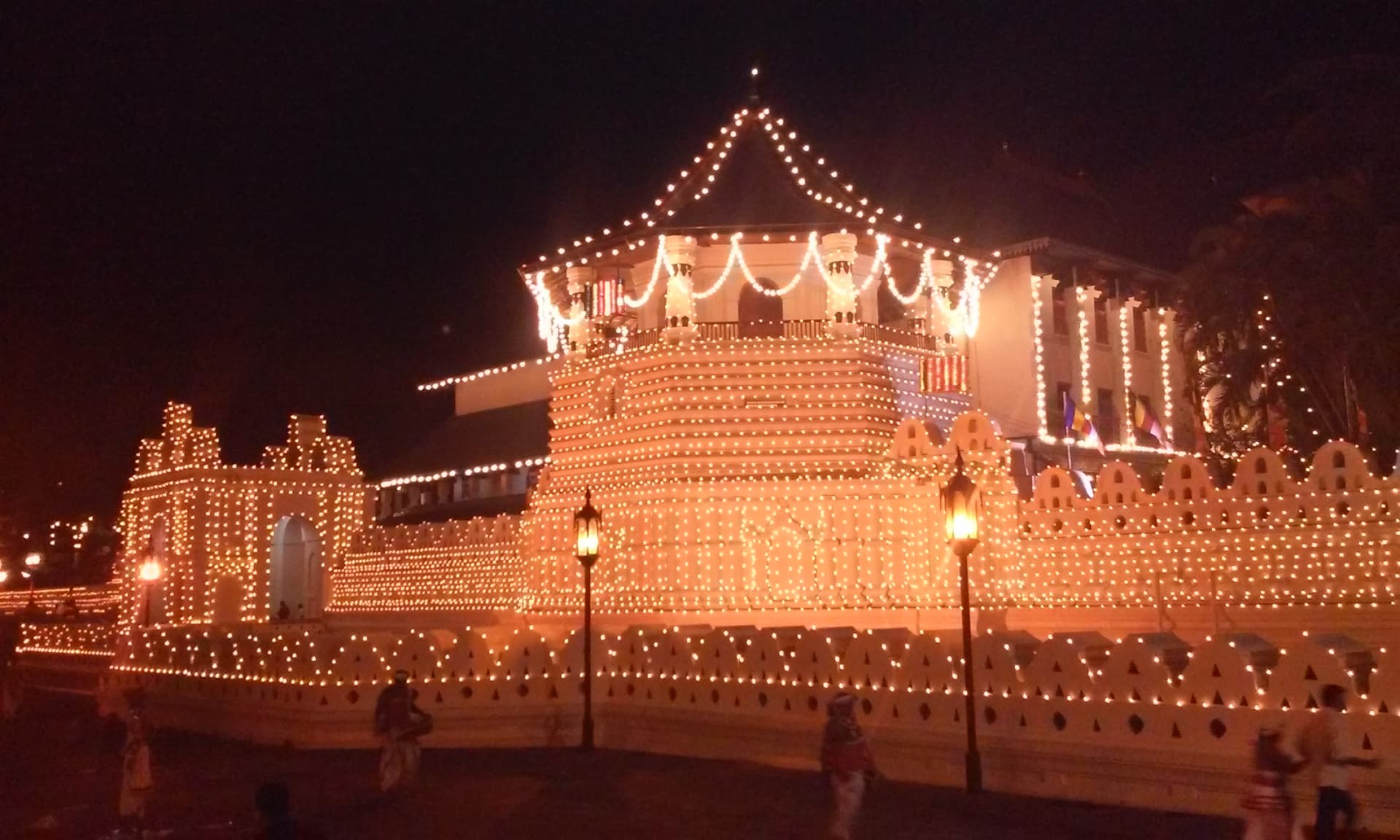
The Kandy Esala Perahera is an annual Buddhist festival in the city of Kandy, Sri Lanka, held in honor of the Sacred Tooth Relic of the Buddha. Perahera means procession, and Esala is the month of the Sri Lankan calendar that falls in July and August. Over ten nights, ending on the full moon, processions of drummers, dancers, torch bearers, and richly dressed elephants move through the streets of Kandy, led by a tusker elephant carrying a golden casket. The festival draws hundreds of thousands of spectators and is among the largest Buddhist festivals in Asia.
The Sacred Tooth Relic
The Buddha, the founder of Buddhism, lived and taught in India around the 5th century BCE. Buddhist tradition holds that after his cremation, his relics were divided and enshrined, and that among them was a tooth, which was preserved in the kingdom of Kalinga in eastern India. According to Sri Lankan tradition, the tooth was brought to the island in the 4th century CE by a princess named Hemamala, who carried it hidden in her hair.
From its arrival, the relic was kept close to the throne. Buddhists came to regard it as representing the living presence of the Buddha, and possession of the relic became bound to the right to rule the island. As the capital of the Sinhalese kings moved over the centuries, from Anuradhapura through a succession of cities, the relic moved with it, and each capital built a shrine to house it. Processions of the relic are documented from the 5th century CE. The relic reached Kandy, the last royal capital, in the late 16th century, and it has been kept there since.
The Temple of the Sacred Tooth Relic
The Temple of the Sacred Tooth Relic, known in Sinhala as the Sri Dalada Maligawa, is located within the old royal palace complex of Kandy. Kandy was the capital of the Sinhalese kings from 1592 to 1815, holding out against the Portuguese and Dutch colonial powers that ruled the island's coasts. The first relic shrine in Kandy was built in the 1590s. During the colonial wars of the 17th and 18th centuries it was destroyed by Portuguese forces, and the rebuilt shrine was later burned by the Dutch. The present temple was built in the early 18th century, and the Paththirippuwa, the octagonal tower at its front, was added by the last king of Kandy in the early 19th century. The relic rests in an inner chamber, enclosed in a series of nested golden caskets. Monks of the Malwatte and Asgiriya chapters, the two senior monastic communities of Kandy, conduct rituals at the shrine three times daily, and the temple's affairs are led by a chief lay custodian, the Diyawadana Nilame. The temple is the center of the Sacred City of Kandy, a UNESCO World Heritage Site.
The Making of the Perahera
Kandy's Esala season carried processions long before the festival took its present shape. The festival as it is known today dates from 1775, in the reign of King Kirti Sri Rajasinha. At that time, the Esala processions of Kandy belonged to the city's four Devales, shrines of the guardian deities Natha, Vishnu, Kataragama, and Pattini, whose veneration blends Buddhist and Hindu tradition. Monks visiting from Siam, present-day Thailand, remarked on the character of the festival, and the king ordered that a procession of the Sacred Tooth Relic lead the four Devale processions. That order created the structure the festival keeps today: the temple's procession at the head, the four Devale processions following. The Perahera was suspended when the British annexed the Kandyan kingdom in 1815, and it resumed in 1828. It has been held annually since.
The Ten Nights
The festival opens at the new moon with the Kap Situweema, the planting of a sanctified wooden pole at each of the four Devales, a vow that the Perahera will be held. The first five nights are the Kumbal Perahera, in which the processions move in simpler form. The last five nights are the Randoli Perahera, named for the golden palanquins once used by the queens of Kandy, which are carried in the procession in their honor. Each night is grander than the last, and the final night, the Maha Randoli Perahera, is the height of the festival.
The processions are led by whip crackers, whose cracks clear the way, followed by flag bearers, torch bearers, lines of Kandyan drummers, and troupes of Kandyan dancers, the classical dance tradition of the region. Elephants walk through the procession in embroidered coverings sewn with lights. At the center walks the Maligawa Tusker, the temple's principal elephant, carrying on its back a golden casket beneath a canopy. The casket holds a replica; the Sacred Tooth Relic itself never leaves the temple. Spectators line the streets in the hundreds of thousands, and many stand as the casket passes.
The Water-Cutting Ceremony
The festival closes at dawn after the final night with the Diya Kepeema, the water-cutting ceremony, held at Getambe on the Mahaweli River a few kilometers from Kandy. Officiants of the Devales wade into the river and cut the water with a sword, drawing vessels of water that are kept at the shrines until the following year's festival, when the water is returned and drawn anew. The rite closes the festival's vow and carries a blessing for the land and the year ahead. A daytime procession, the Day Perahera, is held to mark the completion, and the city returns the relic casket, the dancers, and the elephants to their temples.