Tisha B'Av
Mourning the destroyed Temples
Tisha B'Av, meaning the Ninth of Av, is the major fast day of mourning in Judaism, held each year on the ninth day of the Hebrew month of Av, which falls in July or August. The day mourns the destruction of the First and Second Temples in Jerusalem, which Jewish tradition holds were both destroyed on this same calendar date. It is regarded within Judaism as the saddest day of the year. If the ninth of Av falls on the Sabbath, the fast is postponed by one day.
The Destruction of the Two Temples
The Temple in Jerusalem, located on the hill known today as the Temple Mount, was the center of ancient Jewish worship, the one place where sacrifices were offered according to Jewish law. Jewish tradition attributes the building of the First Temple to King Solomon, the ruler of ancient Israel in the 10th century BCE. The Babylonian empire destroyed the First Temple in 586 BCE when it conquered Jerusalem, and much of the population was taken into exile in Babylon.
The Second Temple was built after the return from that exile, in the late 6th century BCE. King Herod, who ruled Judea under Roman authority in the 1st century BCE, rebuilt and greatly expanded it. In 70 CE, Roman forces burned down the Second Temple while putting down a Jewish revolt against Roman rule. Jerusalem was devastated, and the destruction marked the beginning of a long dispersion of the Jewish people. The Temple has never been rebuilt. Jewish prayer has faced toward its site ever since, and the hope for its rebuilding is a recurring theme of Jewish liturgy.
The Mourning on Tisha B'Av
Early rabbinic tradition lists five calamities that befell the Jewish people on the ninth of Av: the decree that the generation of the Exodus would wander in the desert and not enter the land of Israel, the destruction of the First Temple, the destruction of the Second Temple, the fall of the city of Betar in 135 CE, which ended the last major Jewish revolt against Rome, and the ploughing over of the Temple site by the Romans in the same period.
Over the centuries, the day has come to carry the memory of later tragedies as well. The elegies recited on Tisha B'Av include laments for the massacres of Jewish communities during the Crusades, the expulsions of Jews from England and from Spain, and the Holocaust. Tisha B'Av functions in Jewish life as the day on which the whole weight of this history is mourned together.
The Three Weeks
Tisha B'Av is the end point of a longer period of mourning called the Three Weeks. The period begins with the fast of the Seventeenth of Tammuz, which commemorates the day the walls of Jerusalem were breached before the destruction of the Second Temple. During the Three Weeks, traditional communities hold no weddings or celebrations, and many refrain from music, haircuts, and new clothes. The mourning deepens in the final Nine Days, from the start of the month of Av, when many also refrain from eating meat and drinking wine, except on the Sabbath.
The Fast of Tisha B'Av
The fast of Tisha B'Av lasts roughly 25 hours, from sundown on the eve of the day until nightfall the following evening. Five things are prohibited: eating and drinking, washing the body, applying oils or lotions, wearing leather shoes, and intimate relations. The final meal before the fast is a mourner's meal, traditionally a piece of bread and a hard-boiled egg dipped in ashes, eaten alone.
In the synagogue on the evening of Tisha B'Av, the lights are dimmed, and in many communities the decorative curtain is removed from the ark that holds the Torah scrolls. Worshipers sit on the floor or on low stools, as Jewish mourners do. The Book of Lamentations, a biblical book mourning the destruction of Jerusalem, is chanted in a mournful melody. It is followed by Kinot, poetic elegies composed across many centuries. More Kinot are recited the next morning. Study of the Torah, considered a joyful activity, is limited on this day to texts of sorrow, such as Lamentations, the Book of Job, and passages on the destruction of the Temple. From midday onward, the intensity of mourning eases: worshipers return to ordinary chairs, and the afternoon prayers include a plea for the consolation of Jerusalem.
Tisha B'Av at the Western Wall
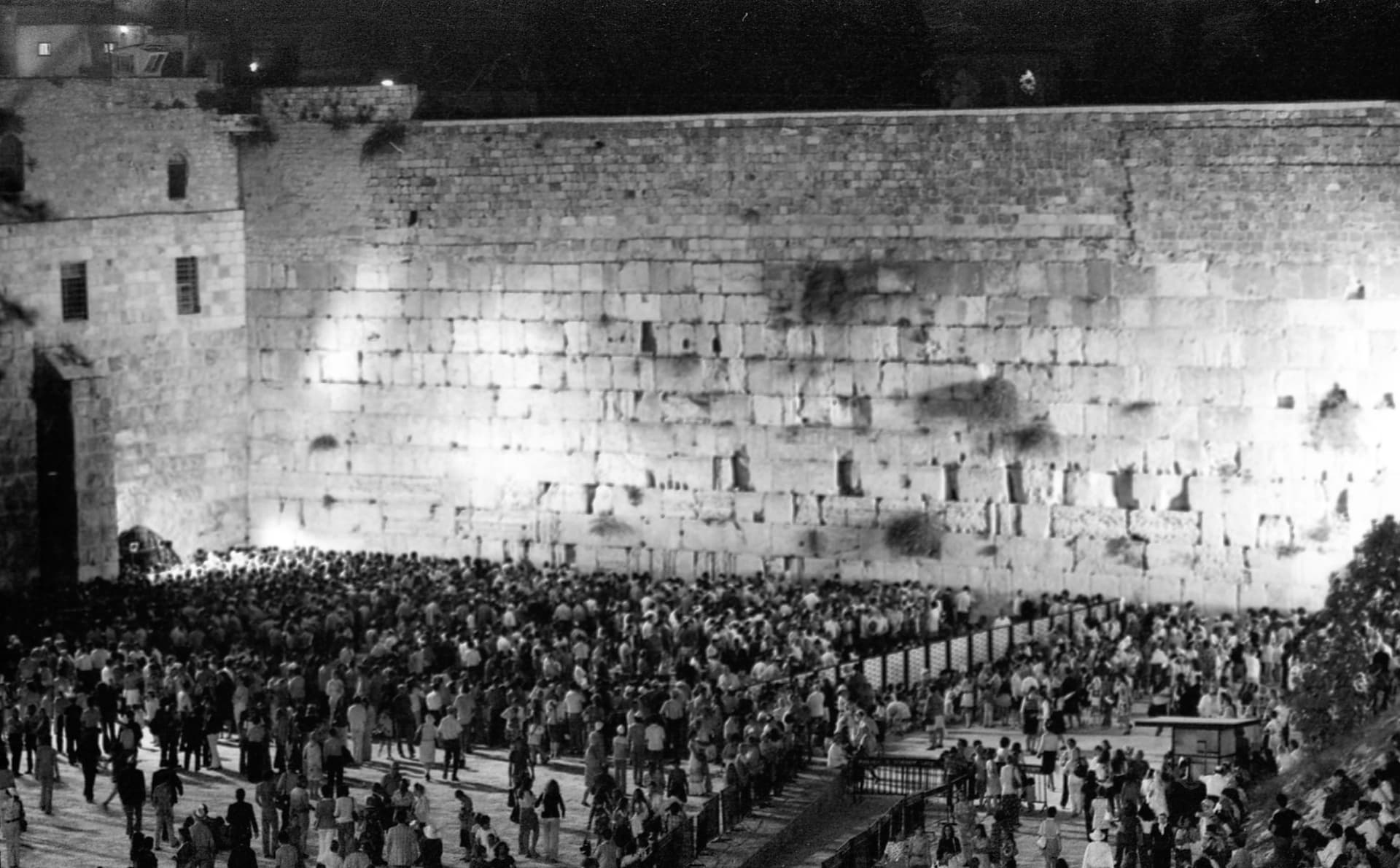
The Western Wall in Jerusalem is a surviving section of the retaining wall that King Herod built around the Temple compound. It is the closest place to the site of the destroyed Temples where Jews gather freely for prayer, and it is a place of continuous Jewish devotion. On the night of Tisha B'Av, thousands of worshipers fill the Western Wall Plaza. They sit on the stone ground in the lamplight and chant Lamentations at the foot of the wall, mourning the destruction at the place where it happened. Prayers, elegies, and gatherings continue at the site through the night and the following day, and the closing prayers of the fast draw large crowds. For many, praying at the Western Wall on Tisha B'Av is the most direct expression of the day: the mourning of the Temple carried out at the closest place to where it stood.
After the Fast
The mourning customs do not end at nightfall. Because tradition holds that the fire that destroyed the Temple burned on into the tenth of Av, the restrictions of the Nine Days are kept until midday of the following day. The Sabbath after Tisha B'Av is called the Sabbath of Comfort, named for the reading from the prophet Isaiah that opens with words of consolation. The weeks that follow carry this theme of comfort forward toward the Jewish New Year. A Jewish tradition holds that the Messiah, the redeemer awaited in Jewish belief, will be born on Tisha B'Av, and that in the messianic age the day of mourning will become a day of joy.