
The Yoshida Fire Festival
The fire festival at the foot of Mount Fuji
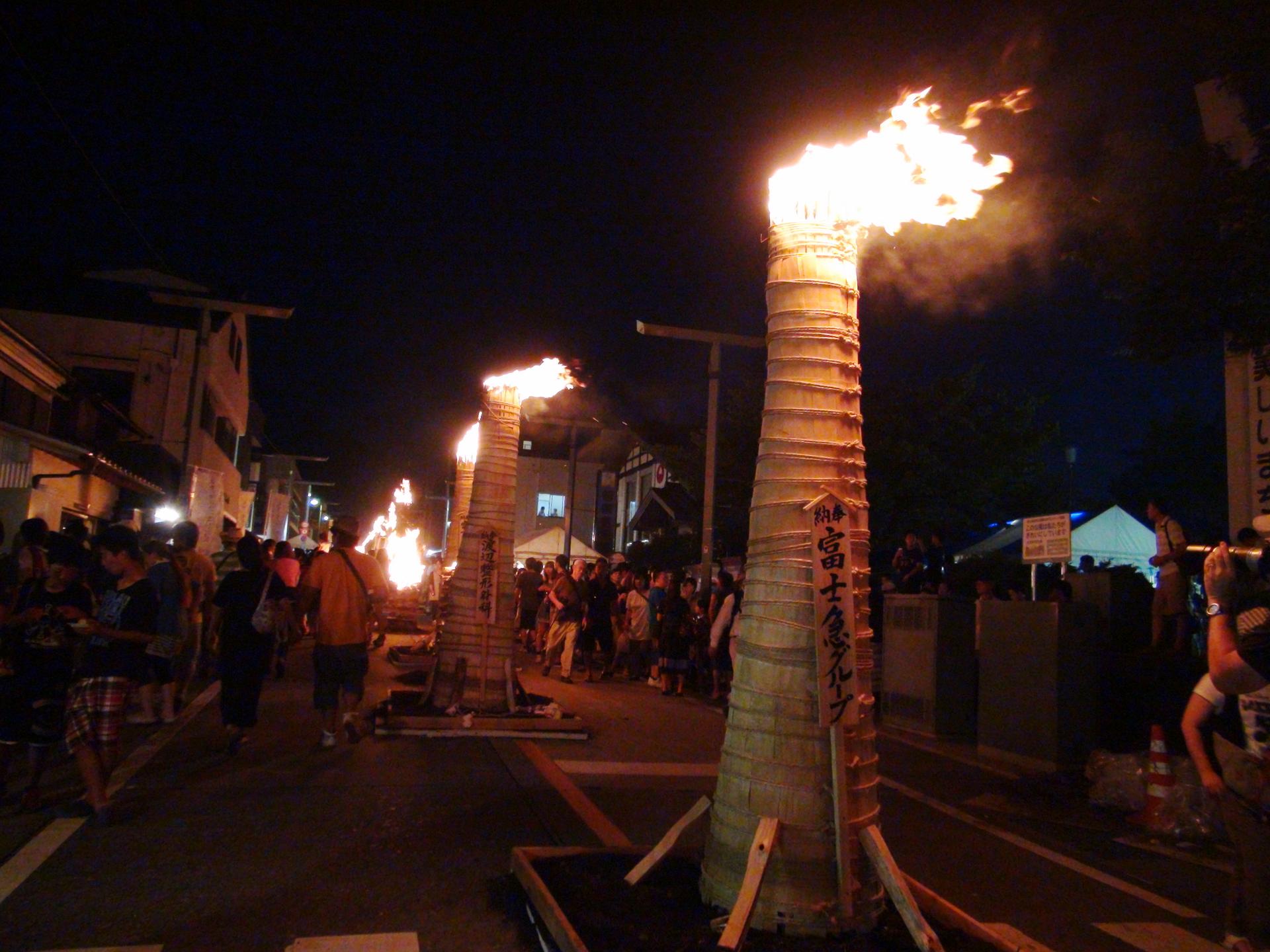
The Yoshida Fire Festival is the annual festival of the Kitaguchi Hongu Fuji Sengen Shrine, a shrine of Shinto, the indigenous religion of Japan, and of the smaller Suwa Shrine on its grounds. Also called Chinka-sai, the festival for calming fire, it is held on 26 and 27 August in the town of Fujiyoshida, at the northern foot of Mount Fuji in central Japan. On the evening of 26 August giant torches are lit along the main street of the town, and two portable shrines in which the deities of the shrine ride are carried through it. Shinto worshipers hold Mount Fuji to be the dwelling of the deity Konohanasakuya-hime, and the purpose of the festival is to calm the eruptions of the volcano by burning fire. The festival also marks the ritual close of the summer climbing season on Mount Fuji, which opens on 1 July. The shrine, the Yoshida trail, and two of the oshi houses are part of the UNESCO World Heritage Site of Mount Fuji, inscribed in 2013.
Mount Fuji and Its Goddess
In Shinto, Mount Fuji is venerated as the dwelling of a kami, a deity or sacred power. Worship of the mountain began as an effort to calm the volcano, which erupted repeatedly in the historical period, and shrines called Sengen shrines were built around its base for this purpose. The Kitaguchi Hongu Fuji Sengen Shrine is located at the start of the Yoshida trail, the main climbing route on the northern side of the mountain. Shrine tradition holds that worship began on this spot in 110 CE and that a shrine was built on the present site in 788, after an eruption of the volcano.
The principal deity of the shrine is Konohanasakuya-hime, the goddess of blossoms, whom the Sengen shrines worship as the goddess of Mount Fuji. Shinto tradition holds that her husband Ninigi, a prince sent down from heaven whom the tradition regards as an ancestor of the emperors of Japan, doubted that the child she carried was his. To prove it, she shut herself into a birth hut without doors, set it on fire, and gave birth to three children unharmed in the flames. For this reason worshipers pray to her for safe childbirth and for protection from fire. The festival takes its meaning from this account: a goddess who was not harmed by fire is asked to keep the fire of the mountain at rest.
A second account belongs to the Suwa Shrine, the older shrine of the village, that was originally connected to the fire festival. Tradition holds that the god of Suwa once fled from pursuers at night, and that the villagers came out to meet him with torches. The pursuers took the lights for an army and turned back. The shrine itself states that the details of this account are unknown.
The Evening of 26 August
The festival begins in the afternoon of 26 August with rites at the main shrine. The deity is then moved to the Suwa Shrine behind a screen of white silk, which hides it from view. At about five in the evening two mikoshi, portable shrine in which a deity is carried through its parish, the district of the people it protects, leave the grounds, to bring the god to the people.
The two mikoshi have different characters. The first has the shape of a small shrine and is carried carefully by older men. The second has the shape of Mount Fuji, is painted red, and weighs about a tonne. Local people call it the honored mountain. It carries the active spirit of the deity, the side of the mountain that erupts. Young men carry it roughly, and along the route they sometimes drop it to the ground. This rough handling is meant to stir up the power of the deity and so calm the raging mountain. The mountain-shaped mikoshi is never allowed to overtake the other one.
The two mikoshi are carried to a temporary shrine in the town, where they rest overnight. As soon as they are set down, the giant torches along the main street are lit one after another. Each torch is about three meters tall and close to a meter across, built of bundled wood in the shape of a bamboo shoot. The street is lined with about eighty to more than a hundred of them, and the number varies from year to year. In front of the houses, families build smaller stacks of red pine about a meter and a half high and light them at the same time. At the same hour, fires are lit at the mountain huts on the slopes of Mount Fuji, so that the town and the mountain burn together. Sacred dances are performed for the deity at the temporary shrine during the night.
Local tradition holds that sparks from the torches land on the roofs but that no house has ever caught fire. The next morning people gather the charred ends of the torches and keep them as charms against fire and for safe childbirth and health, the things for which the goddess of the mountain is asked. Households that have had a death in the past year stay away from the festival and do not look at the fire or the mikoshi, since death is regarded in Shinto as a source of impurity that must be kept apart from the deity.
The Pilgrims of Mount Fuji
The main street where the torches burn is the street of the oshi, the families who receive pilgrims to Mount Fuji, give them lodging and food, instruct them in the faith, and pray with them before the climb. The pilgrims come in organized groups called Fuji-ko, associations of lay believers who pool their money so that some of their members can climb the mountain on behalf of all. They gather around the burning torches at the old oshi houses and recite their prayers there.
The Day of 27 August
On the second day the mikoshi, together with children's mikoshi, are carried through the whole parish. The mountain-shaped mikoshi is carried before the railway station of the town to pray for safety on the mountain, and the other mikoshi before the bronze gate at the entrance of the old pilgrim quarter to pray for peace in the parish.
After dark the mikoshi run back into the shrine grounds and circle a grove in front of the Suwa Shrine several times. Worshipers follow them carrying stalks of pampas grass as offerings and pray for safe childbirth, for children, and for health. For this reason the second day is also called the Pampas Grass Festival. The deities are then returned to the Suwa Shrine and the main sanctuary in quiet rites late at night, which end the festival.
Additional Resources
- Yoshida no Himatsuri, Cultural Heritage Online, Agency for Cultural Affairs (in Japanese)
- Fujisan, Sacred Place and Source of Artistic Inspiration, UNESCO World Heritage Centre
- H. Byron Earhart, Mount Fuji: Icon of Japan (University of South Carolina Press, 2011)