
The Kanwar Yatra
Carrying Ganga water to Shiva in the month of Shravan
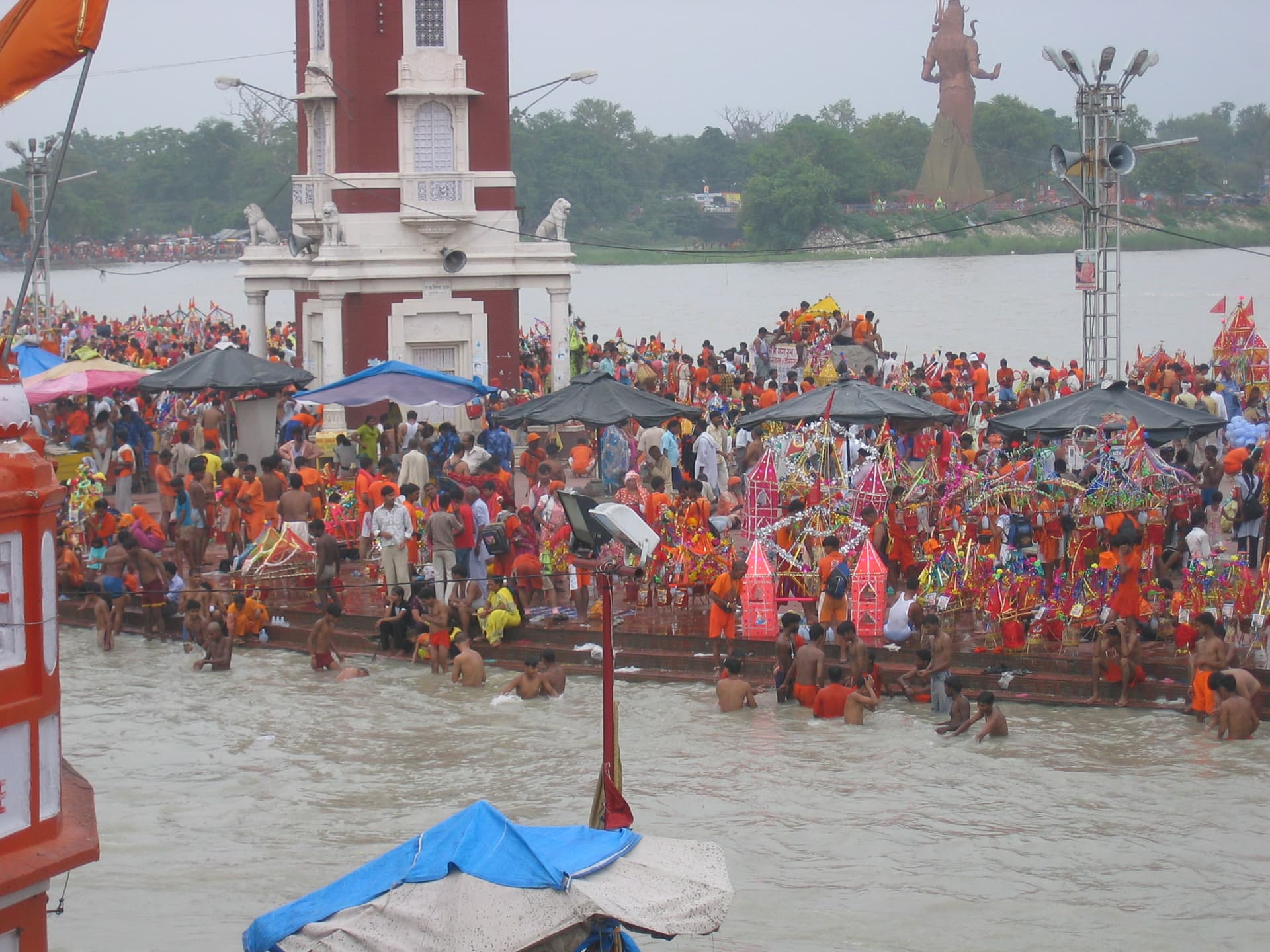
The Kanwar Yatra is an annual Hindu pilgrimage in which millions of devotees of Shiva, one of the principal deities of Hinduism, carry water from the River Ganges to Shiva temples. The pilgrimage takes place during Shravan, a month of the Hindu calendar that falls in July and August. Hindus dedicate this month to the worship of Shiva. The pilgrimage ends on Sawan Shivaratri. Shivaratri is a night dedicated to Shiva that recurs each lunar month.
The pilgrims are called Kanwariyas, after the Kanwar, a bamboo pole balanced across the shoulders with a decorated water vessel suspended from each end.
The Water Offering
The pilgrims pour the water they carry over a Shiva lingam, the abstract stone form in which Shiva is worshiped. Hindus regard Ganga water as purifying, and Hindu tradition holds that the ritual bathing of a sacred image with water (Jalabhishek) performed during Shravan carries particular merit. Many pilgrims undertake the walk in fulfillment of a vow connected to a prayer answered or a blessing sought.
Hindu tradition links the practice to the churning of the cosmic ocean, an account in which gods and demons churned the ocean to obtain the nectar of immortality. A poison emerged first, and Shiva drank it to protect the world. Ganga water was poured over him to cool the burning of the poison. The pouring of water over the lingam recalls this account.
The Kanwar follows specific rules. Once filled, it must not touch the ground. Pilgrims rest by hanging the pole on stands set up along the routes. For the duration of the walk, many Kanwariyas keep a vegetarian diet and abstain from intoxicants and intimate relations. Stricter forms of the pilgrimage exist as well. In the Dak Kanwar, relay teams keep the water moving without pause. In the Khari Kanwar, the pilgrim remains standing while companions hold the pole during rests.
The Routes of the Kanwar Yatra
The Kanwar Yatra follows several routes. The busiest begin at Haridwar, Gaumukh, and Gangotri in the state of Uttarakhand, and at Sultanganj in the state of Bihar, where the Ganges flows briefly northward, a direction Hindus consider auspicious. From these collection points, pilgrims carry the water to Shiva temples across Uttarakhand, Uttar Pradesh, Delhi, Haryana, Rajasthan, Bihar, and Jharkhand.
From Sultanganj, pilgrims walk about one hundred kilometers to the temple of Baba Baidyanath Dham in Deoghar, Jharkhand. Hindus venerate this temple as one of the twelve Jyotirlingas, shrines where Hindu tradition holds that Shiva manifested as a column of light. The walk from Sultanganj to Deoghar is known as the Shravani Mela. It continues throughout the month of Shravan, and camps, kitchens, and aid stations line the way.
Scale and Growth
The offering of Ganga water to Shiva is a long-established practice, and written accounts of Kanwar pilgrims date back to at least the 19th century. For most of its history, the pilgrimage was small, undertaken largely by ascetics and older devotees. From the late 1980s onward it grew into a mass pilgrimage. Tens of millions of pilgrims now take part each year, supported by improved road networks and organized infrastructure along the routes. Many pilgrims are young men, many from poor and working-class backgrounds. During the pilgrimage weeks, traffic on the main corridors is restricted and daily life in the towns along the routes is heavily affected.
Additional Resources
- Vikash Singh, Uprising of the Fools: Pilgrimage as Moral Protest in Contemporary India (Stanford University Press, 2017)