
The Manimahesh Yatra
The Himalayan pilgrimage to Shiva's lake
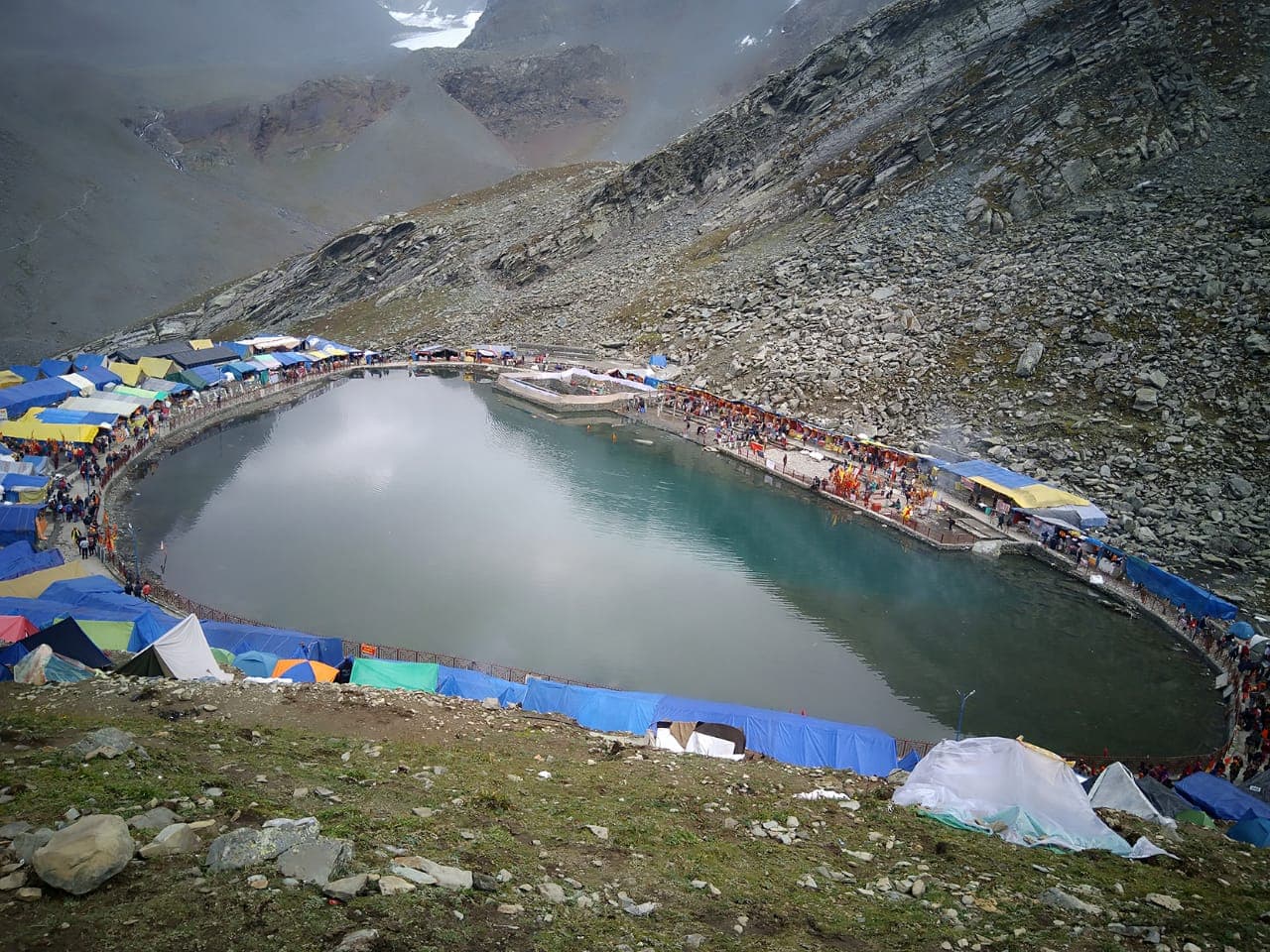
The Manimahesh Yatra is the annual Hindu pilgrimage to Manimahesh Lake, a glacial lake at about 4,190 meters (13,750 feet) at the foot of Manimahesh Kailash peak in Chamba district, Himachal Pradesh, India. Hindus regard the peak as an abode of Shiva, the god of destruction and renewal in the Hindu trinity, and the lake as the place where he bathes. The pilgrimage runs for about two weeks in the Hindu lunar month of Bhadrapada (August or September), and its central act is a ritual bath in the lake. Hundreds of thousands of pilgrims take part over the course of the season.
The Date of the Manimahesh Yatra
The Yatra opens on Krishna Janmashtami, the festival marking the birth of Krishna, an incarnation of the god Vishnu, and closes fifteen days later on Radhashtami, the festival marking the birth of Radha, Krishna's consort. A first ritual bath is taken in the lake on Janmashtami. The main bath takes place at dawn on Radhashtami, and most pilgrims time their journey to reach the lake on or just before that day. Hindu tradition holds that a bath in the lake between these two festivals brings purification and the blessing of Shiva. The lake is frozen for much of the year, and the two weeks of the Yatra fall at the end of the brief high-altitude summer.
Shiva and Manimahesh Kailash
Shiva is one of the principal deities of Hinduism. Hindu tradition places his home on Mount Kailash in Tibet, and several Himalayan peaks are venerated as forms of Kailash. Manimahesh Kailash, 5,656 meters (18,556 feet) high, is one of them. The name combines Mani, a jewel, and Mahesh, a title of Shiva meaning the great lord. Hindu tradition holds that a jewel on the crown of Shiva rests on the summit, and pilgrims regard the flash of light from the snow and ice on the peak as that jewel.
According to Hindu tradition, Shiva made the peak his abode after his marriage to Parvati, the mountain goddess who is his consort. Another traditional account holds that Shiva performed penance at the site for hundreds of years, and that the water flowing from his matted hair formed the lake.
Pilgrims regard the peak as impossible to climb. According to Hindu tradition, a shepherd who tried to climb the mountain with his flock was turned to stone, and a rock formation below the peak is identified with him. The mountaineering record differs, since a climbing expedition has been credited with reaching the summit, but pilgrim tradition continues to describe the peak as unclimbed.
At dawn, when the first sunlight strikes the peak, its reflection appears in the still water of the lake. Pilgrims regard the reflected image as a form of Shiva's presence, and many time their bath to coincide with it.
The Gaddi
The Gaddi are a pastoral community of the western Himalaya whose homeland is the Bharmour area of Chamba district. Their traditional livelihood is the seasonal movement of sheep and goats between high summer pastures and low winter grazing. The Gaddi are devotees of Shiva. Gaddi tradition holds that Shiva created the Gaddi and gave them their way of life. They call the Bharmour region Shiv Bhumi, the land of Shiva, and regard Manimahesh Kailash as his seat within it.
The Yatra is closely tied to the Gaddi calendar. The summer grazing season in the high pastures ends around the time of the pilgrimage, and Gaddi families travel to the lake before the descent to winter grounds. The Yatra serves as a gathering of the community as well as an act of devotion.
Bharmour and the Chaurasi Temple Complex
Bharmour, at about 2,135 meters, is the main town of the region and the base of the pilgrimage. It was the capital of the kingdom of Chamba for roughly four centuries before the capital moved to Chamba town in the 10th century. The Chaurasi Temple Complex is located at the center of Bharmour. Chaurasi means eighty-four, and the complex takes its name from the eighty-four shrines it is said to contain, which Hindu tradition connects with eighty-four perfected ascetics said to have meditated at the site. The complex dates to the 7th century. Its central temple is dedicated to Shiva as Manimahesh, and Hindu tradition holds that the pilgrimage is incomplete without a visit to it. Pilgrims pray there before setting out for the lake.
The Procession from Chamba
A formal procession leads the pilgrimage from Chamba town to the lake. It carries a holy mace regarded as an emblem of Shiva, together with a trident, Shiva's weapon, and other insignia. Hindu tradition in Chamba holds that the procession was instituted by the king who founded Chamba town in the 10th century, which gives it a history of about a thousand years. It is led by the head of a monastery of Shaiva ascetics in Chamba, followed by ascetics, lay pilgrims and district officials. The procession leaves Chamba about a week before Radhashtami, halts at fixed places along the way, and reaches the lake on the eve of Radhashtami. The pilgrims who walk with it go barefoot and sing devotional songs along the route.
The Route to the Lake
The main approach runs 65 kilometers by road from Chamba to Bharmour, then 13 kilometers further to the roadhead at Hadsar. From Hadsar pilgrims walk about 13 to 14 kilometers to the lake, climbing about 2,000 meters. Most spend the night at a halting place beside a waterfall about halfway up, and reach the lake on the second day. The return takes one day. Alternative routes cross high passes from Lahaul in the north and from Kangra and Mandi districts in the south, following the paths that Gaddi shepherds use for their seasonal migrations. During the Yatra volunteer groups run free community kitchens at halts along the route, and the district administration registers pilgrims and provides medical posts.
The Bath in the Lake
About one and a half kilometers short of the lake are two bathing places. One is regarded as the pool where Parvati bathed before her marriage to Shiva, and women pilgrims bathe there. The other is regarded as the bathing place of Shiva, and men pilgrims bathe there. These baths precede the bath in the main lake.
On arrival at the lake, pilgrims bathe in its water. Hindu tradition holds that the bath should be taken as the first light of the sun falls on the peak. After the bath, pilgrims walk around the lake three times in a clockwise circuit, an act of reverence that Hindus perform at sacred sites. A marble image of Shiva is located on the shore, and pilgrims make offerings there. They also pray toward the peak itself, offering flowers and lamps in the direction of the summit.
The Radhashtami bath is the climax of the season. On the eve of Radhashtami the procession reaches the lake, and at dawn the ascetics who lead it take the first bath, followed by the assembled pilgrims. Most pilgrims begin the descent the same day.
- → Manimahesh Lake
- → Krishna Janmashtami. The Hindu celebration of the birth of Krishna
- → Mount Kailash
Additional Resources
- Manimahesh Yatra, District Chamba, Government of Himachal Pradesh
- Hermann Goetz, The Early Wooden Temples of Chamba (E.J. Brill, 1955)