
The Amarnath Yatra
The Himalayan pilgrimage to the ice lingam
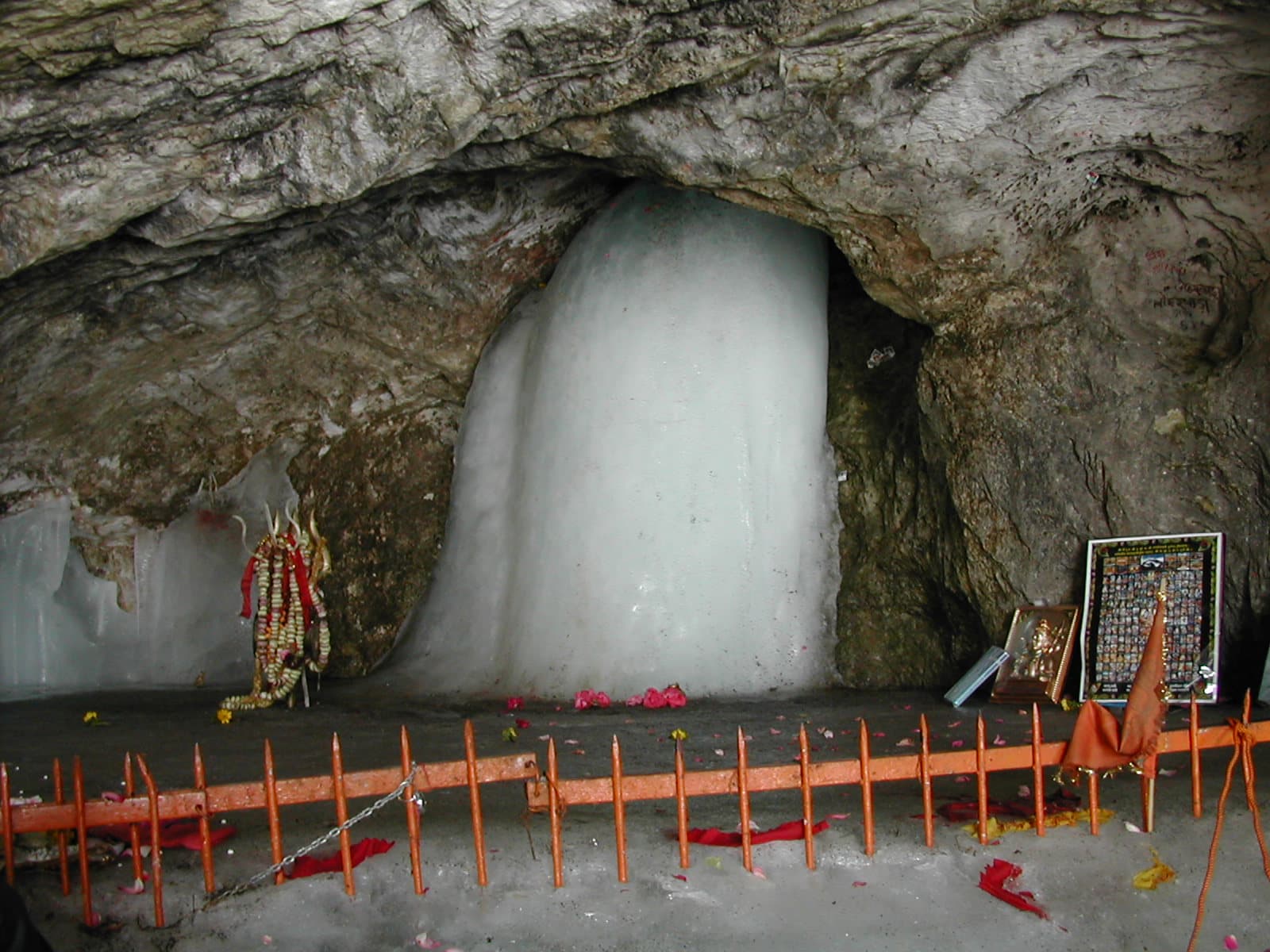
The Amarnath Yatra is an annual Hindu pilgrimage to the Amarnath Cave, a shrine located at 3,888 metres in the Himalayas of the Kashmir region of India. The object of the pilgrimage is a natural pillar of ice that forms inside the cave each year, which Hindus revere as a lingam, the symbolic form of the deity Shiva. The Yatra, the Sanskrit-derived word for pilgrimage, takes place during the Hindu month of Shravan, from late June or early July to the full moon in August, the only weeks of the year when the cave is accessible. Hundreds of thousands of pilgrims make the journey on foot each season.
The Cave and the Ice Lingam
The Amarnath Cave is a natural cave high on a mountainside in the Anantnag district of Jammu and Kashmir, above the valleys that lead up from the town of Pahalgam. Snow closes the cave for most of the year. Inside, water dripping from the roof freezes into a stalagmite, a column of ice rising from the floor, which grows and shrinks with the season. Hindus revere this column as a lingam, the upright form in which Shiva is worshipped. It is often called the ice lingam, and the deity of the cave is popularly addressed as Baba Barfani, the lord of ice.
Two smaller ice formations near the main column are regarded as Parvati, the consort of Shiva, and Ganesha, their son. Hindu tradition holds that the lingam waxes and wanes with the phases of the moon, reaching its fullest form on the full moon of Shravan. The shrine has no built structure. The cave itself, and the ice within it, are the sanctuary.
The Story of the Amar Katha
According to Hindu tradition, the Amarnath Cave is the place where Shiva revealed the Amar Katha, the secret of immortality, to Parvati. The tradition recounts that Parvati asked Shiva why she died and was reborn again and again while he remained immortal, and Shiva agreed to tell her the secret. To make sure no living being could overhear it, he sought out the most remote place in the mountains and shed everything he carried along the way. He left his bull Nandi at Pahalgam, released the moon from his hair at Chandanwari, left his snakes at the lake of Sheshnag, parted from Ganesha at the Mahagunas mountain, and finally left behind the five elements at Panjtarni before entering the cave with Parvati alone. The tradition adds that a pair of pigeons overheard the secret and became immortal, and pilgrims regard the sight of a pair of pigeons at the cave as an auspicious sign.
The stages of this account are the stages of the pilgrimage. The traditional route to the cave passes through Pahalgam, Chandanwari, Sheshnag, the Mahagunas pass, and Panjtarni, and pilgrims walk the same sequence of places where, in the tradition, Shiva laid down his attachments one by one.
The History of the Pilgrimage
The cave appears in old Sanskrit texts of Kashmir, and a 12th-century history of the region records that a ruler of Kashmir visited the ice lingam. Pilgrims have made the journey for many centuries despite the difficulty of the terrain.
Kashmiri folklore tells of a Muslim shepherd named Buta Malik, who is said to have received a sack of coal from a wandering holy man. On reaching home he found the sack full of gold, and when he returned to thank the man, he found the cave in his place. For generations, a share of the pilgrims' offerings at the shrine went to the shepherd's descendants, and the story is told as an expression of the bond between the shrine and the people of the valley.
Hindu tradition also tells of an ancient sage who taught his followers the significance of the cave and sent them on the pilgrimage. When the pilgrims were threatened on the way, the tradition holds that Shiva gave the sage a mace to protect them. This mace is identified with the Chhari Mubarak carried to the cave today.
The Yatra
The Amarnath Yatra is organized each year by the Shri Amarnathji Shrine Board, which announces the dates of the season. The pilgrimage runs for several weeks, in recent years around 45 days, and ends at the full moon of Shravan, which coincides with the festival of Raksha Bandhan in August.
Two routes lead to the cave. The traditional route begins at Pahalgam and covers roughly 46 kilometres through Chandanwari, Sheshnag, and Panjtarni, a walk of three to five days with overnight camps. The second route begins at Baltal and is far shorter, roughly 14 kilometres, but steeper, and strong walkers complete it in a day. The two paths meet before the final climb to the cave. The trek crosses passes above 4,000 metres, and the altitude and sudden mountain weather make the journey physically demanding. Severe storms have cost pilgrims' lives in past seasons.
Along both routes, volunteers run Langars, free community kitchens that serve meals, tea, and water to every pilgrim. Camps, medical posts, and helpers with ponies accompany the season. Pilgrims walk chanting invocations of Shiva, and the exchange of the greeting associated with the deity accompanies the whole route. At the cave, pilgrims climb the final steps barefoot, stand before the ice lingam for Darshan, the beholding of the deity, and make their offerings.
The Chhari Mubarak
The culminating tradition of the Yatra is the procession of the Chhari Mubarak, the holy mace of Shiva. The silver mace is kept in Srinagar, the main city of the Kashmir valley, and is carried on foot from Srinagar to the cave in a ceremonial procession led by its custodian, accompanied by ascetics and pilgrims. The mace arrives at the cave on the full moon of Shravan, the most significant day of the season, when tradition holds the ice lingam stands at its fullest. The arrival of the Chhari Mubarak closes the Yatra for the year.
The Pilgrimage Under Guard
The Yatra takes place in the Kashmir region, where the Kashmir conflict is ongoing. Pilgrims and pilgrimage convoys have been targeted in attacks at intervals since the 1990s, and the pilgrimage is held under extensive security arrangements, with forces posted along both routes. The number of pilgrims has nonetheless remained in the hundreds of thousands each season, and the Langars, the shared routes, and the long history of the shrine in Kashmiri life continue to carry the Yatra each summer.