
The Pandharpur Wari
Maharashtra's walking pilgrimage to Vitthal
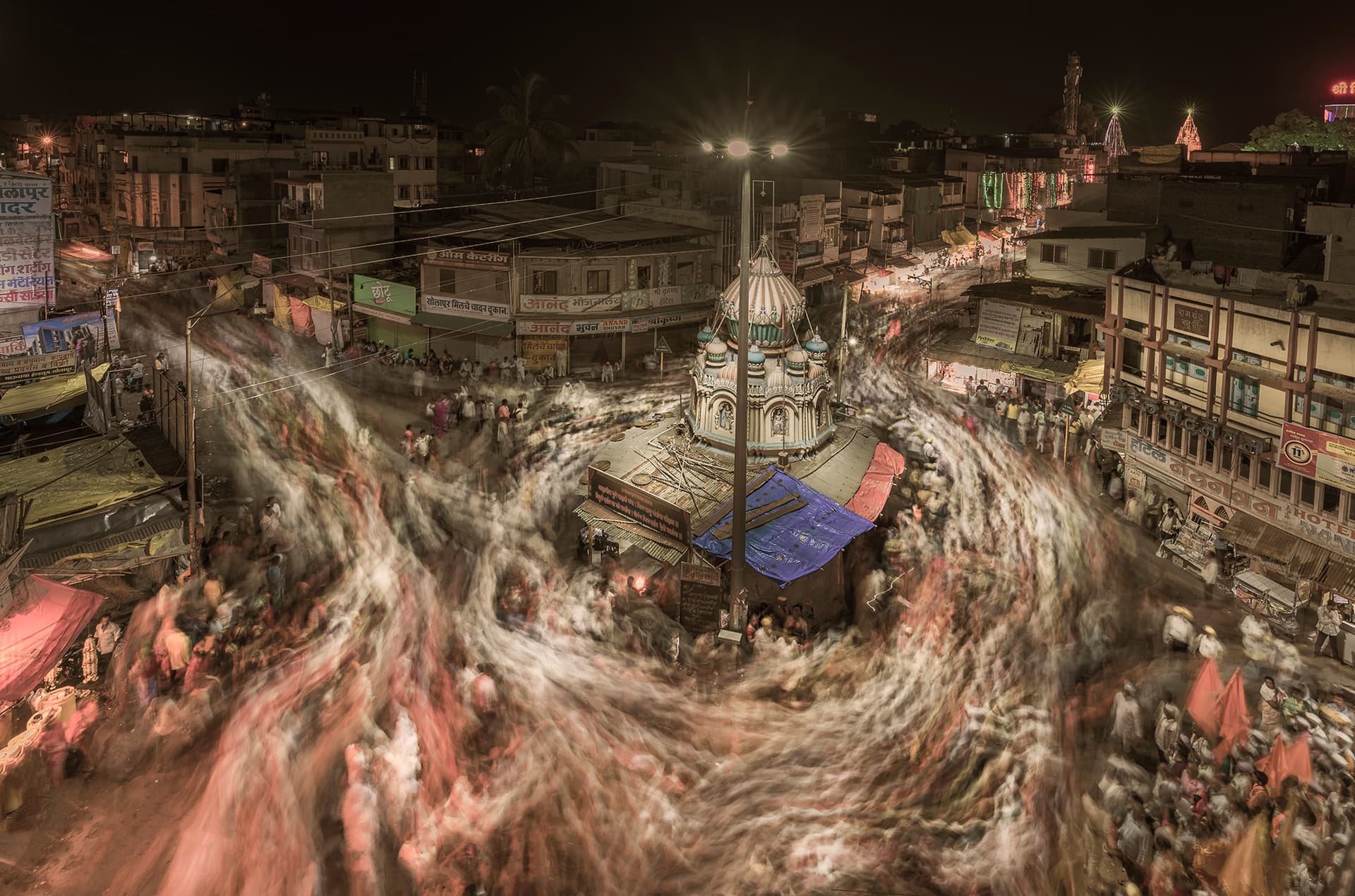
The Pandharpur Wari is an annual walking pilgrimage in the Indian state of Maharashtra to the temple of the Hindu deity Vitthal in the town of Pandharpur. Pilgrims walk for weeks in organized processions, singing devotional songs, and arrive for Ashadhi Ekadashi, the eleventh day of the bright half of the Hindu month of Ashadha, which falls in June or July. The Wari has been walked for more than seven centuries. Participation is measured in the hundreds of thousands, and the gathering at Pandharpur for Ashadhi Ekadashi draws over a million people.
Vitthal and Pandharpur
Vitthal, also called Vithoba and Panduranga, is a Hindu deity worshipped mainly in Maharashtra and Karnataka. Hindus regard him as a form of Vishnu, one of the principal deities of Hinduism, in his incarnation as Krishna. His image shows him as a dark young figure standing upright on a brick, hands resting on his hips.
The posture is explained by the account of Pundalik, which Hindu tradition attaches to the origin of the temple. According to the tradition, Pundalik was a devotee who was absorbed in the care of his elderly parents when the deity came to visit him. Not willing to interrupt his duty, Pundalik tossed a brick out for the visitor to stand on and asked him to wait. Moved by this devotion to his parents, the deity chose to remain standing on the brick, and he stands there still, waiting for his devotees. The name Vitthala is traditionally explained as "one standing on a brick."
Pandharpur is located on the Bhima river, which is called the Chandrabhaga at Pandharpur for the crescent shape of its bend. The Vitthal Rukmini Temple, where Vitthal is worshipped together with his consort Rukmini, is the destination of the Wari.
The Varkari Tradition
The pilgrims of the Wari are called Varkaris, a Marathi word meaning "those who perform the Wari." The Varkari tradition is a devotional movement within Hinduism that grew in Maharashtra from the 13th century as part of the wider Bhakti movement, which taught that direct personal devotion to God is open to everyone, regardless of caste, learning, or wealth.
The tradition was shaped by a line of poet-saints. Dnyaneshwar, a 13th-century saint, composed a celebrated Marathi commentary on Hindu scripture and gave the movement its philosophical foundation. Namdev, born in Pandharpur in the 13th century, spread devotion to Vitthal through his songs. Eknath in the 16th century and Tukaram in the 17th century carried the tradition forward. These saints composed Abhangs, devotional songs in Marathi addressed to Vitthal, and the singing of Abhangs is the sound of the Wari to this day. Varkaris wear strings of beads made from the wood of the Tulsi plant, a basil regarded as sacred in Hinduism, and greet one another as Mauli, meaning mother, a name of affection used for both Dnyaneshwar and the deity.
The Palkhi Processions
The heart of the Wari is the Palkhi, a palanquin carrying the Padukas, the symbolic sandals, of a saint. The two principal Palkhis are those of Dnyaneshwar, which sets out from the town of Alandi, where the saint's shrine is located, and of Tukaram, which sets out from the town of Dehu, his home. Both towns lie near the city of Pune. The tradition of carrying the saints' Padukas to Pandharpur was begun in 1685 by Narayan Maharaj, the youngest son of Tukaram. The procession was reorganized in the 1820s into the form used today.
The two Palkhis travel separate routes of roughly 250 kilometres over about three weeks, and dozens of smaller Palkhis from other towns join along the way. The pilgrims walk in Dindis, organized groups, each with its place in the procession, its own singers and cymbal players, and its own arrangements for food and rest. Villages and towns along the routes host the pilgrims as the procession passes. At set points along the way the procession halts for the Ringan, a ritual in which a riderless horse, regarded as carrying the spirit of the saint, runs a circuit through the assembled pilgrims, who then race along its path. The two great Palkhis converge at the village of Wakhari, just outside Pandharpur, before entering the town together on the eve of Ashadhi Ekadashi.
Ashadhi Ekadashi
The Wari culminates on Ashadhi Ekadashi, also called Shayani Ekadashi. Hindu tradition holds that on this day Vishnu begins a four-month cosmic sleep, a period called Chaturmas that is set aside for devotion and restraint. On this day the pilgrims bathe in the Chandrabhaga river and go for Darshan, the act of standing in the presence of the deity and beholding the image, at the Vitthal Rukmini Temple. The town fills far beyond its size, and the queues for Darshan run through day and night. Many pilgrims who cannot reach the sanctum regard the sight of the temple and the bath in the river as the completion of their Wari.
A second, smaller Wari takes place in the month of Kartik, in October or November, ending on Kartiki Ekadashi, which Hindu tradition holds to be the day Vishnu wakes from his sleep.
The Wari Today
The Wari is one of the largest recurring pilgrimages in India, and it has been walked continuously through centuries of political change. Whole families walk together, and many Varkaris have performed the Wari every year of their adult lives. The pilgrimage is known for its openness: men and women, farmers and city dwellers, and people of all castes walk side by side. For the duration of the walk, the pilgrims live simply, sing the devotional songs of the saints, and carry the same greeting to everyone they meet on the road.
Additional Resources
- D. B. Mokashi, Palkhi: An Indian Pilgrimage, translated by Philip C. Engblom (State University of New York Press, 1987)