
Ganesh Chaturthi
The Hindu festival of Ganesha's birth
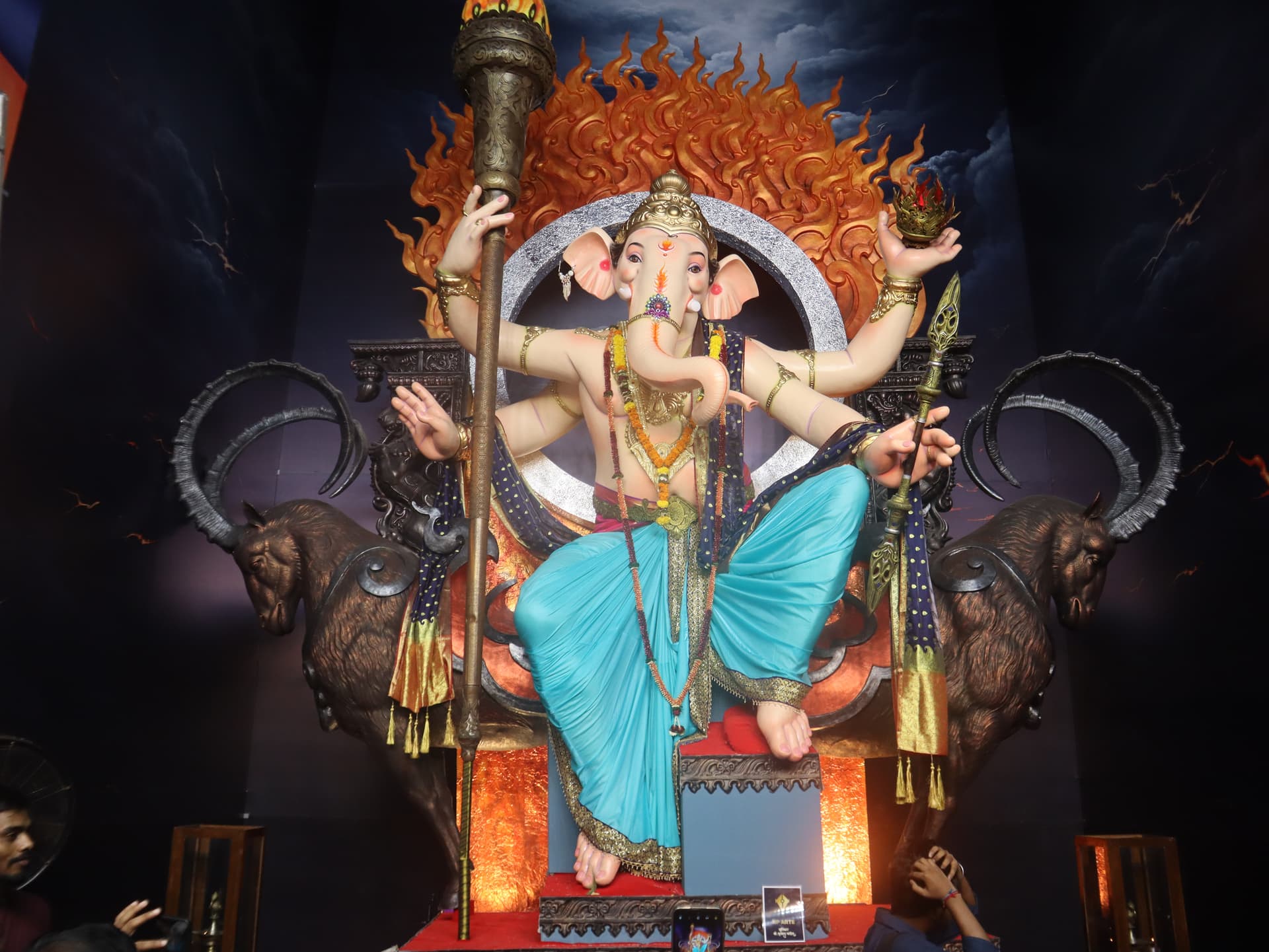
Ganesh Chaturthi is the Hindu festival that celebrates the birth of Ganesha, the elephant-headed god. Hindus worship Ganesha as the remover of obstacles and the god of wisdom and new beginnings. Many Hindus pray to him before starting anything new, from a journey or a business to a wedding or an exam. During the festival, families and communities welcome an image of Ganesha into their homes and into public halls, and worship him there for up to ten days. On the final day, the image is carried in procession to a river, lake, or sea and immersed in the water. The festival is celebrated across India and in Hindu communities abroad. It is at its largest in the western state of Maharashtra, where it is the main festival of the year.
About Ganesha
Ganesha, also called Ganapati and Vinayaka, is the son of the god Shiva and the goddess Parvati. He is shown with the head of an elephant, a round belly, one broken tusk, and a mouse or rat as his mount. Hindus regard him as the remover of obstacles and the god of beginnings, wisdom, and good fortune. For this reason Hindus invoke him at the opening of a ritual, before any other deity is addressed. His image is placed at the entrance of homes and temples and at the start of a new undertaking, whether a marriage, a journey, a business, or a book.
Hindu tradition tells his birth in several versions. In the most widely told account, Parvati shaped a boy from the paste she used to wash her body and set him to guard her door while she bathed. Shiva, returning home, did not know the boy and was refused entry. In the fight that followed, Shiva cut off the boy's head. When Parvati grieved, Shiva promised to restore the boy with the head of the first creature he found, which was an elephant. Shiva then made him the leader of the Ganas, the hosts of attendants who serve Shiva. Shiva also declared that Ganesha would receive worship before all other gods.
Ganesha appears as a distinct deity in Indian sculpture from around the fifth century CE. Over the following centuries his worship spread through the subcontinent and, with Hindu and Buddhist traders, to Southeast Asia, China, and Japan. Today Hindus of every tradition include him in their worship.
The Date of Ganesh Chaturthi
Ganesh Chaturthi falls on the fourth day of the waxing moon in the lunar month of Bhadrapada, which corresponds to August or September in the Western calendar. The name of the festival carries its date: Chaturthi is the word for the fourth day of a lunar fortnight. Hindu tradition holds that this is the day of Ganesha's birth.
The festival runs for up to ten days and ends on Anant Chaturdashi, the fourteenth day of the same waxing moon, which is the main day of immersion. Families may keep their image for fewer days and immerse it earlier, while public images are kept for the full ten days.
The Rituals of Ganesh Chaturthi
Preparations begin weeks ahead. Sculptors in Maharashtra and other states create images of Ganesha in clay or, in recent decades, in a quick-setting white plaster, ranging from a few centimeters to several meters high. Families choose an image and bring it home on the eve of the festival or on the morning of the first day. Streets in cities such as Mumbai and Pune are lined with stalls selling images, flowers, and decorations.
On the first day the image is placed on a decorated platform in the home or in a temporary public hall. A priest or the head of the family performs a rite that invites the deity into the image, after which the image is treated as Ganesha himself, present as a guest in the house. Worship follows, with offerings of flowers, especially red hibiscus, blades of durva grass, coconut, and sweets. The most important sweet is the modak, a steamed rice-flour dumpling filled with coconut and jaggery, which Hindu tradition describes as Ganesha's favorite food.
For the days that the image stays in the house, the family performs worship in the morning and evening. The evening worship ends with a hymn of praise sung while lamps are waved before the image. Relatives and neighbors visit each other's homes to see the images and receive sweets. In public halls, the days are filled with devotional music, recitals, plays, and community meals.
The Public Festival
Ganesh Chaturthi was a household festival for most of its history; at the end of the nineteenth century Ganesha images began to be installed openly in public spaces in Pune for shared worship, with processions, speeches, and performances.
Public celebration became common first in Pune and Mumbai and then throughout Maharashtra and beyond. It is organized by neighborhood committees that raise funds, commission an image, build a temporary hall, and run the ten days of worship and events.
The Immersion
The festival ends with the immersion of the image, called Visarjan ("farewell"). Each family or committee decides how many days it keeps its image, and on the day it has set, it performs a final worship and asks Ganesha to leave the image. The image is then carried in procession to a body of water, accompanied by drums, dancing, and the chant "Ganpati Bappa Morya," a Marathi call to Ganesha, with the words "come again early next year." The image is lowered into the water and left to dissolve.
Hindu tradition holds that Ganesha returns to his home on Mount Kailash, the mountain that Hindus regard as the dwelling of Shiva, and takes the troubles of the household with him. The dissolving of the clay is also understood as a reminder that every form, including the body, is temporary.
On Anant Chaturdashi, the final day, the processions in Mumbai and Pune bring millions of people into the streets. In Mumbai the largest images are carried to the sea at the beaches of Chowpatty and Juhu, and the immersions continue through the night into the following morning.
Ganesh Chaturthi Across India and Beyond
Maharashtra is the center of the festival, with Mumbai and Pune as its two main cities. Goa celebrates it largely as a household festival of shorter duration. Karnataka, Telangana, Andhra Pradesh, Gujarat, and Madhya Pradesh hold large public celebrations. In Tamil Nadu and other Tamil-speaking areas the festival is called Vinayagar Chaturthi, after Vinayagar, the Tamil name of Ganesha, and is celebrated mainly at home and in temples on a single day. Hindu communities in Nepal, Mauritius, Malaysia, Singapore, Fiji, the United Kingdom, and North America install images and hold processions where local rules allow.