
Guru Nanak Gurpurab
The Sikh celebration of the birth of Guru Nanak
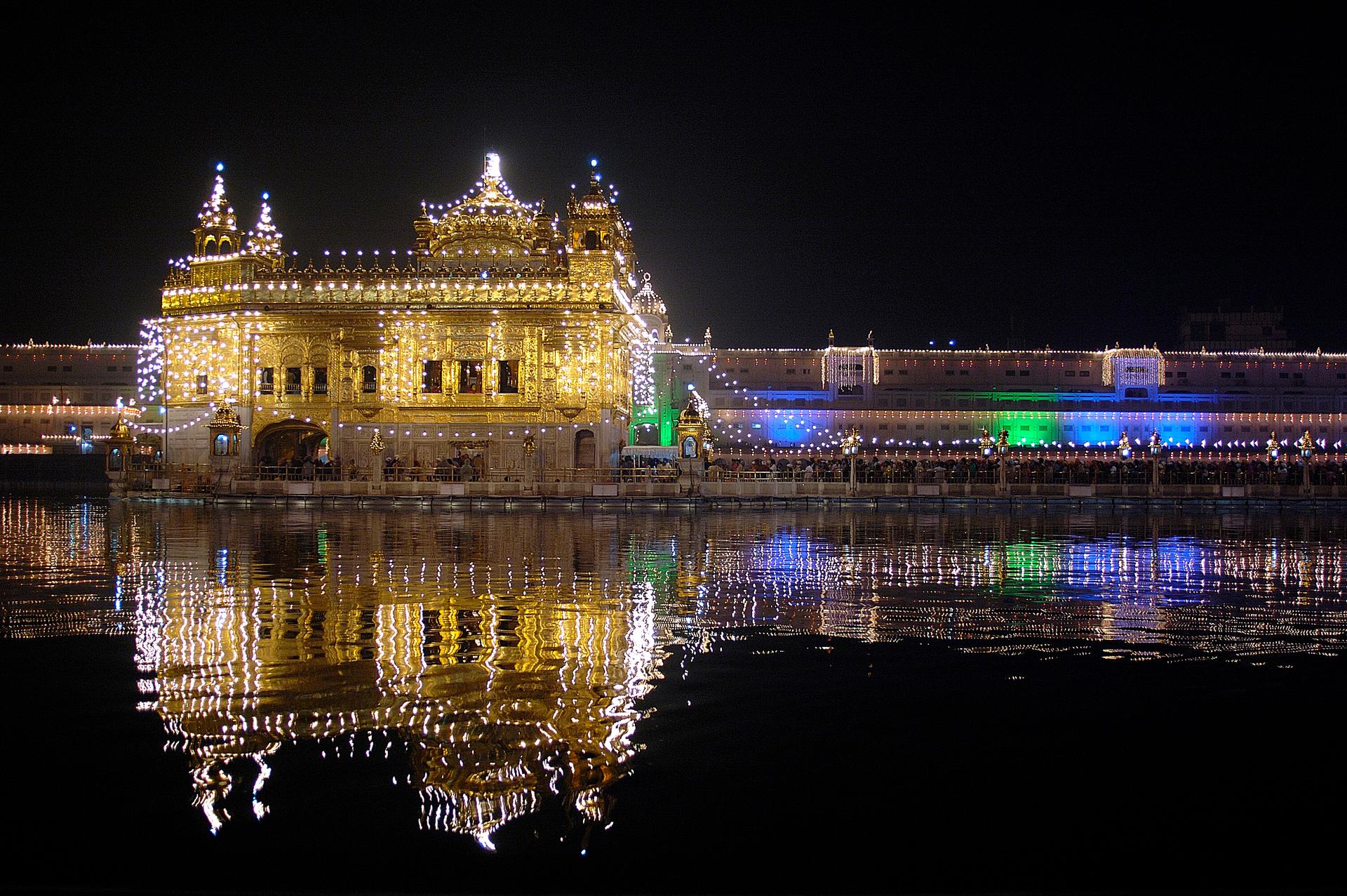
Guru Nanak Gurpurab is the celebration of the birth of Guru Nanak, the founder of Sikhism, and one of the principal festivals of the Sikh year. Gurpurab means the holy day of a Guru, and Sikhs use the word for the anniversaries of their ten Gurus, the teachers who led the community from Guru Nanak's time until 1708. The celebration falls on the full moon of the month of Kattak in the lunisolar calendar, in October or November. Sikhs mark it with an unbroken reading of their scripture, a procession through the streets, worship that begins before dawn, and a free meal open to everyone. At the place of his birth, Nankana Sahib in Pakistan, the celebration draws Sikh pilgrims from Pakistan, from India across the border, and from Sikh communities around the world. At the Sri Harmandir Sahib (Golden Temple) in Amritsar, India, the temple and its pool are lit with lamps.
About Guru Nanak
Guru Nanak was born in 1469 in the village of Rai Bhoi di Talwandi, in the Punjab, a region in the northwest of the Indian subcontinent named for the five rivers that flow through it (the Jhelum, the Chenab, the Ravi, the Beas, and the Sutlej) and today divided between Pakistan and India. The village is now called Nankana Sahib after him. He was born into a Hindu family, and his father was the village accountant.
Sikh tradition holds that, at about the age of thirty, Guru Nanak went to bathe in a river near the town of Sultanpur Lodhi, where he worked, and did not come out for three days. Sikhs believe that during these days he was taken into the presence of God and given his mission. When he returned, he declared that God makes no distinction between Hindu and Muslim. With this he taught that the way to God lies beyond the boundaries of any one religion.
Guru Nanak then traveled for many years through India and beyond, as far as Mecca according to Sikh tradition. A Muslim musician, Mardana, went with him and played while he sang his hymns. Guru Nanak taught that there is one God, present in all of creation, and that all people are equal before God, whatever their caste or gender. Sikhs sum up his teaching in three duties: to keep God's name in mind at all times, to earn a living by honest work, and to share what one earns with others.
In his last years he settled as a farmer at Kartarpur, on the Ravi river, where a community of followers gathered around him. There he began the langar, the free community kitchen, in which everyone sat together on the ground and ate the same food, regardless of caste. At the time, people of different castes did not eat together. He died at Kartarpur in 1539. Nine Gurus followed him, each chosen by the one before. In 1708 the tenth Guru, Guru Gobind Singh, declared that after him the Guru Granth Sahib, the Sikh scripture, would be the Guru. Sikhs have since revered the scripture as their living Guru. It holds nearly a thousand hymns of Guru Nanak.
The Date of Guru Nanak Gurpurab
The Shiromani Gurdwara Parbandhak Committee, the elected body that manages the historic gurdwaras (Sikh places of worship) in India, holds the celebration on the full moon of Kattak, and Sikhs around the world follow this date. An older Sikh tradition places his birth in the spring month of Vaisakh, in April, and some Sikhs hold that the spring date is the true one.
The Celebration of Guru Nanak Gurpurab
The celebration begins two days before the birthday with an Akhand Path, an unbroken reading of the whole Guru Granth Sahib, which takes about forty-eight hours. Readers take turns day and night, so that the reading never stops, and it ends on the morning of the birthday. Since Sikhs revere the scripture as the Guru, hearing it read from beginning to end is a way of being in the Guru's presence for the whole festival.
In many towns, in the weeks before the festival, groups of Sikhs walk through the streets in the early morning singing hymns, to wake the neighborhood to the coming day.
On the day before the birthday, the congregation holds a Nagar Kirtan, a procession through the town with the singing of hymns. The Guru Granth Sahib is carried at its center in a decorated palanquin. The procession is led by the Panj Pyare, who are called "the five beloved ones": five Sikhs who stand for the first five men to be initiated into the Sikh community by Guru Gobind Singh in 1699, and who are honored as models of devotion. The procession carries the Guru's word through the streets of the town to everyone who lives there.
On the birthday itself, the congregation gathers in the gurdwara, the place of worship, at four or five in the morning, in the hours before dawn that Sikhs regard as the best time for prayer, to sing a morning hymn of Guru Nanak. Singing of hymns, talks that explain them, and prayers continue through the day. At the end of the worship everyone receives a sweet offering of wheat flour, clarified butter, and sugar, blessed during the prayers, which is shared equally as a gift of the Guru. The langar, the community kitchen, serves a meal to all who come, Sikh or not. Volunteers cook, serve, and clean, and the guests sit in rows on the floor and eat the same food. This is the institution Guru Nanak began at Kartarpur, and it puts his teaching that all people are equal into practice. Gurdwaras are lit for the night, and the singing of hymns often continues until late.
The Gurpurab at Nankana Sahib
The central celebration in Pakistan takes place at Gurdwara Janam Asthan in Nankana Sahib, the shrine built over the place where Sikh tradition holds that Guru Nanak was born. It is hosted by the Evacuee Trust Property Board, the Pakistani state body that looks after Sikh shrines in the country, together with the Pakistan Sikh Gurdwara Parbandhak Committee, the body of Pakistani Sikhs that oversees worship in the gurdwaras. Groups of Sikh pilgrims from India cross the border for the festival under a protocol on visits to religious shrines that India and Pakistan signed in 1974. Sikhs from Pakistan and from communities around the world join them.
During the celebration the Guru Granth Sahib is carried in a palanquin in procession from Gurdwara Janam Asthan through the town to Gurdwara Kiara Sahib, which marks the field where Sikh tradition holds that the young Nanak grazed his family's cattle. Pilgrims also visit the other gurdwaras of the town that mark scenes of his childhood. Many travel on to the gurdwara at Kartarpur, where he spent his last years and died. For the five hundred and fiftieth anniversary of his birth in 2019, India and Pakistan opened a corridor across the border so that pilgrims from India could reach Kartarpur without a visa. In May 2025 the corridor was closed by India after a military conflict between India and Pakistan in the Kashmir region.
The Gurpurab at the Golden Temple
The Sri Harmandir Sahib (Golden Temple) in Amritsar is the principal gurdwara of Sikhism. It is located in the middle of a sacred pool and houses the Guru Granth Sahib. On the night of Guru Nanak Gurpurab the temple, the buildings around the pool, and the walkway along its edge are lit with electric lights and oil lamps, and fireworks are set off over the water. Devotees light small lamps at the edge of the pool, as a sign of the light that Sikhs believe Guru Nanak brought into the world.
- → The Calendars Behind Sacred Days. How Sun and Moon set the dates of sacred days
- → Nankana Sahib
- → Sri Harmandir Sahib (Golden Temple)
Additional Resources
- Gurpurbs, Shiromani Gurdwara Parbandhak Committee
- Gur Purab: Celebrating the 1's Greatness of Guru Nanak Sahib, by Harinder Singh, Sikh Research Institute
- Nikky-Guninder Kaur Singh, The First Sikh: The Life and Legacy of Guru Nanak (Penguin Viking, 2019)