
Inti Raymi
Cusco's festival of the sun at the June solstice
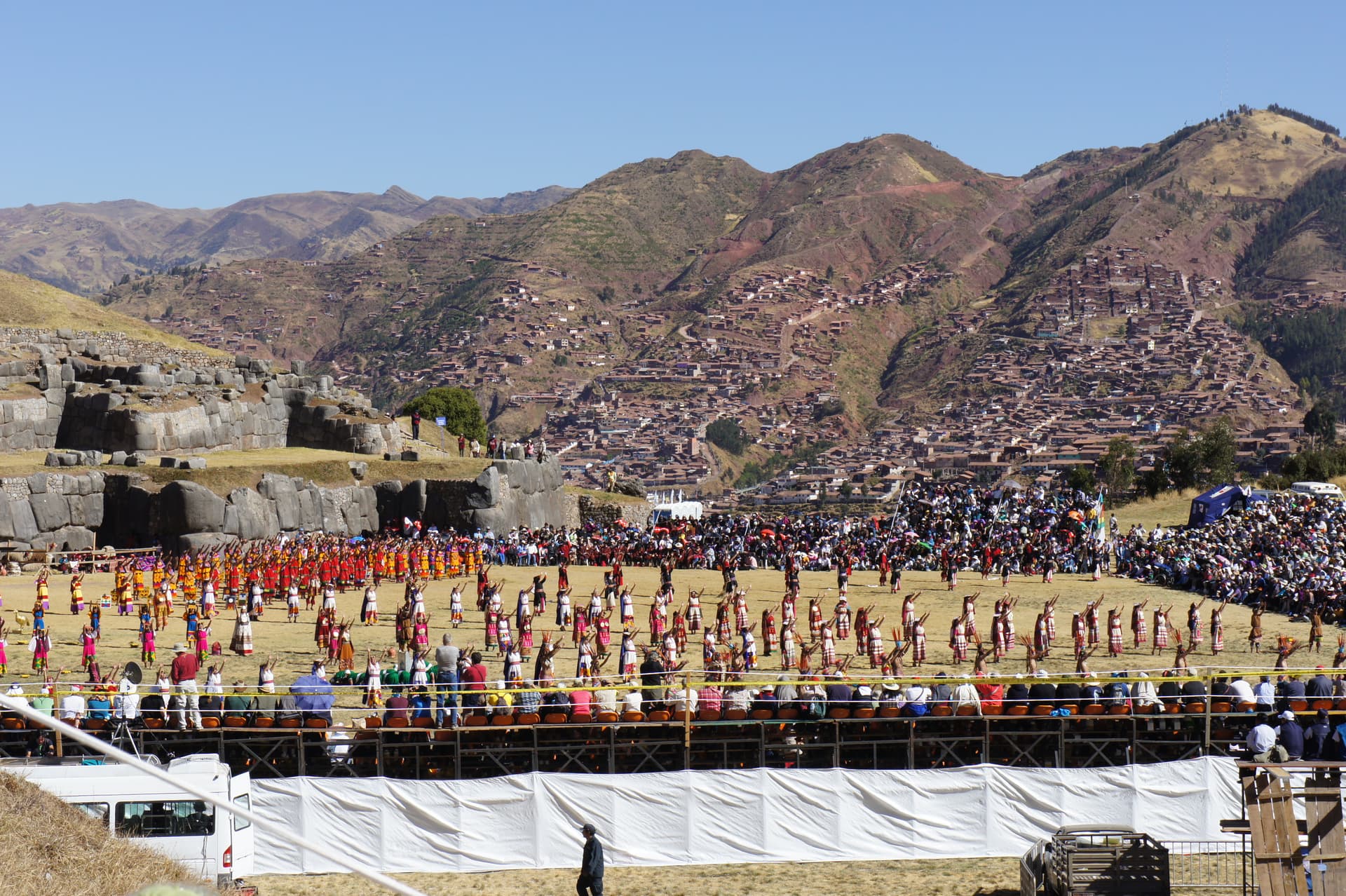
Inti Raymi is the festival of the sun held in Cusco, Peru, every year on 24 June, a few days after the winter solstice of the southern hemisphere. The name is Quechua, the language of the Inca, and means festival of the sun. The ceremony honors Inti, the sun, whom the Inca regarded as their principal deity and the ancestor of their ruling line. The festival celebrated today is a reconstruction. It was staged for the first time in 1944, four centuries after the Spanish conquest had ended the original rite, and it has been held every June since, with a few interruptions. It takes place in three settings in and above the city: Qorikancha, the Inca temple of the sun; the main square; and the hillside complex of Sacsayhuaman, where the central ceremony is performed before tens of thousands of spectators.
The Festival of the Sun under the Inca
The Inca state, which ruled much of the Andes from Cusco in the 15th and 16th centuries, kept a calendar of religious festivals tied to the agricultural year. The June solstice is the shortest day of the year in the southern Andes. Andean tradition holds that the sun is weakest at this point and that the festival asked Inti to return and to bring the next cycle of planting and harvest.
The festival was preceded by days of fasting. Nobles and delegations from the four regions of the empire gathered in Cusco. At dawn the ruler greeted the rising sun from the main square, then called Haukaypata, and offered it a drink of chicha, a fermented maize beer. Llamas were sacrificed, and the priests read omens for the coming year in their entrails. Food, drink, and sacred bread were shared. The festival closed with music, dance, and feasting over several days.
After the Spanish conquest of Cusco in the 1530s, the colonial authorities banned the festival together with other Inca religious practices. Qorikancha was handed to the Dominican order, which built its church and convent over the temple. Elements of sun worship survived in the countryside in altered forms, often folded into the Catholic feast of St John the Baptist, which falls on 24 June.
The Reconstruction of 1944
In 1944 a group of Cusco intellectuals revived Inti Raymi as part of a wider effort to restore the Inca past and Quechua culture to public life. A script was written in Quechua from the accounts of the festival that had survived from the colonial period. The first celebration took place on 24 June 1944 on the esplanade of Sacsayhuaman, which offered the space for a large ceremony. The same day was established as the Day of Cusco. The festival has been held every year since, except in 1950 after an earthquake that damaged the city, in 1970 after the earthquake in Yungay, and in 2020 and 2021 during the pandemic.
The revived Inti Raymi is a staged ceremony rather than an unbroken tradition from Inca times. It is held in the Inca settings and is the central public rite of the Andean year in Cusco. Hundreds of performers from the city take the roles of the Inca ruler, his wife the Coya, priests, soldiers, and the delegations of the four regions. The roles of the ruler and the Coya are filled each year by public competition. The municipal festival company of Cusco organizes the event. In 2001 the Peruvian state declared Inti Raymi part of the Cultural Heritage of the Nation.
The Three Settings
The ceremony moves through three places in a single day. The scene in the main square is open to anyone in the streets; the scenes at Qorikancha and at Sacsayhuaman are watched from grandstands.
It opens in the morning at Qorikancha, on the terraces below the church of Santo Domingo. Under the Inca, Qorikancha was the principal temple of the sun, and its walls were sheathed in gold. Here the performer representing the ruler greets the sun and makes the first offering of the day.
The procession then moves through the streets to the main square, the Plaza de Armas, which is located on the site of Haukaypata. In this second scene, known as the encounter of two worlds, the mayor of Cusco meets the Inca and reports on the state of the city, and the ruler addresses the crowd.
In the afternoon the ceremony reaches Sacsayhuaman, the walled complex of massive stone terraces on the hill above the city. Here the central rites are performed on a stage. The delegations of the four regions of the empire, Chinchaysuyu, Antisuyu, Collasuyu, and Contisuyu, report to the ruler and bring their offerings. The ruler drinks chicha and offers it to the sun. A sacred fire is lit. Under the Inca a llama was then sacrificed and its entrails were read for omens for the coming year; in the revived ceremony the sacrifice is acted out and no animal is killed. Sacred bread is shared. The ceremony ends with dances from the four regions and a general outburst of celebration.
Inti Raymi Across the Andes
The Cusco festival is the best known Inti Raymi, but it is not the only one. Indigenous communities in Peru, Bolivia, Ecuador, and northern Argentina celebrate the June solstice with ceremonies of their own, often on 21 June, the solstice itself, with offerings to the sun and to Pachamama, the earth regarded in Andean tradition as a living mother who gives and sustains life. In Cusco the solstice is marked as the Andean New Year with ceremonies at archaeological sites around the region. In Ecuador the festival is kept by Kichwa communities with music, masked dancers, and shared food.
The Month of Cusco
In Cusco, 24 June is the climax of a month of celebrations known as the jubilee month. It opens on 1 June with offerings to Pachamama. Corpus Christi, the Catholic feast in which the images of fifteen saints and virgins from the city's parishes are carried through the main square, falls in the same weeks. Parades of traditional dances from the thirteen provinces of the region fill the days before the festival. The jubilee month places the revived Inca rite beside the Catholic processions of the colonial city in a single season of public ceremony.
- → Qorikancha
- → The Calendars Behind Sacred Days. How Sun and Moon set the dates of sacred days
- → Pachamama. The Andean month of offerings to Mother Earth
Additional Resources
- City of Cuzco, Smarthistory
- City of Cuzco, UNESCO World Heritage Centre
- Brian S. Bauer, Ancient Cuzco: Heartland of the Inca (University of Texas Press, 2004)