Meskel
Ethiopia's feast of the Finding of the True Cross
Meskel is the feast of the Ethiopian Orthodox Church that celebrates the finding of the True Cross, the cross on which Christians believe Jesus was crucified. Christian tradition holds that the cross was lost after the death of Jesus and found again three centuries later. Christians venerate it as a relic, an object that connects them to Jesus through his physical contact with it, and its recovery is the event the feast marks. Meskel is celebrated every year on 27 September, with a bonfire lit on the evening before. The word Meskel means "cross" in Ge'ez, the ancient language of the Ethiopian liturgy. The feast is a national holiday in Ethiopia and Eritrea, and it is one of the two largest religious celebrations of the year in both countries, together with Timkat, the January feast of the baptism of Jesus.
The Finding of the True Cross
Christian tradition holds that Helena, the mother of the Roman emperor Constantine, traveled to Jerusalem in the fourth century to search for the cross of the crucifixion, which had been buried after the death of Jesus. In the Ethiopian account, Helena did not know where to dig. She was told to light a fire and follow its smoke. The smoke bent down and touched the ground at the place where the cross lay buried, and there she found three crosses. The true one was identified when a sick person was healed by touching it.
Fragments of the True Cross were sent to churches across the Christian world in the centuries that followed. Ethiopian tradition holds that one fragment came to Ethiopia in the early fifteenth century. It was placed in the church of Gishen Mariam, a monastery on a flat-topped mountain in the Wollo highlands of northern Ethiopia. The Ethiopian Orthodox Church holds that the fragment is still there, and the church draws hundreds of thousands of pilgrims on 1 October, the feast that marks its arrival at Gishen.
The Date of Meskel
Meskel falls on 17 Meskerem in the Ethiopian calendar, which is 27 September in the Western calendar, or 28 September in the year before a Western leap year. It comes ten days after the Ethiopian new year and marks the end of the long rainy season. At this time the highlands turn yellow with a small daisy that blooms only in these weeks and is called the Meskel flower. The flower is part of the celebration everywhere.
The Ethiopian Orthodox Church keeps a second feast of the cross in March, on the tenth day of Megabit, the Ethiopian month that runs from the middle of March to the middle of April. This feast recalls the finding itself. Ethiopian Orthodox tradition holds that the main celebration was moved to September so that it would not fall in Lent, the period of fasting before Easter.
The Demera
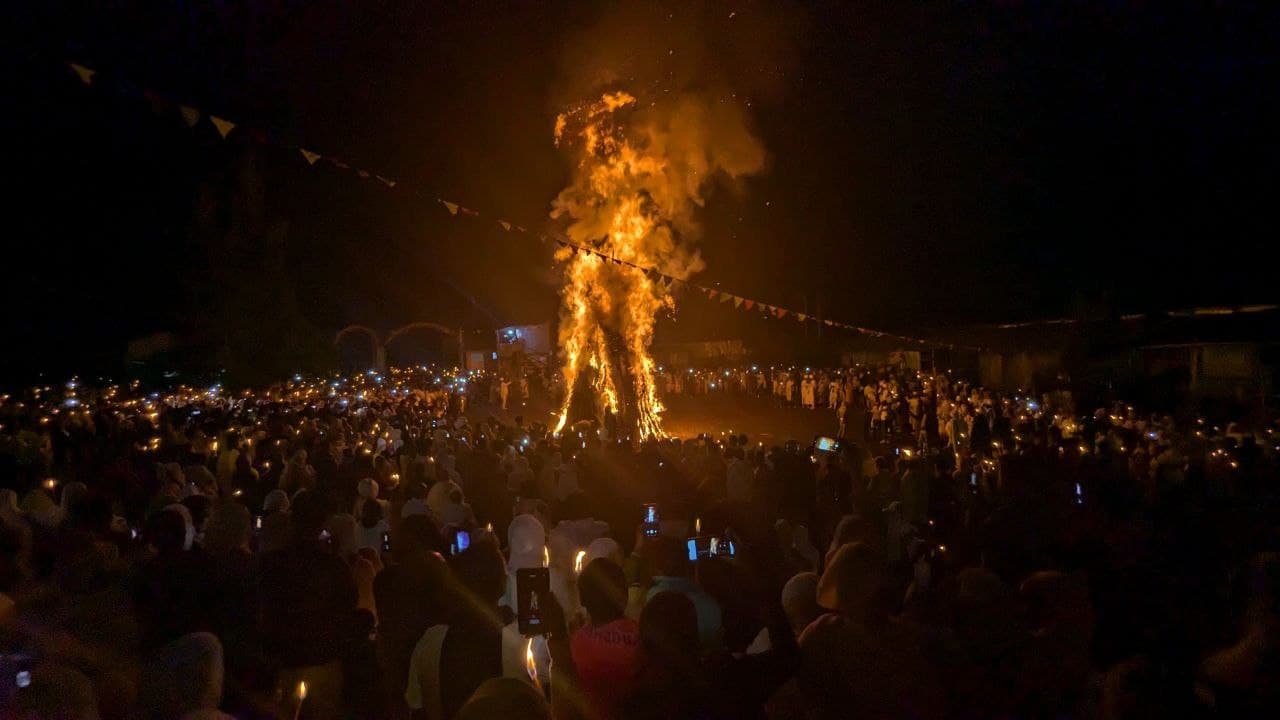
The center of the feast is the Demera, a large bonfire that is lit on the evening before Meskel and that recalls the fire whose smoke led Helena to the cross. On the afternoon of 26 September, branches and logs are stacked into a tall cone, topped with a cross decorated with Meskel flowers, in the main square of every town and in front of churches and homes in villages. The largest Demera is built in Meskel Square in Addis Ababa, the capital, where the square and the stands around it hold tens of thousands of people.
In the late afternoon, priests, deacons, and church choirs in white robes, and often the Patriarch himself in Addis Ababa, gather at the Demera. They sing hymns, beat drums, and move around the pyre in a slow circling dance that the Ethiopian church uses in its liturgy, while the crowd holds lit candles or torches. Sermons are given and the story of Helena is retold. As darkness falls, the church leaders and civic leaders light the Demera together. The fire burns through the evening, and the crowd sings and watches until the cross at the top falls.
The direction in which the burning pyre collapses is read by many as a sign for the year ahead, whether the harvest will be good and where peace will hold.
The Day of Meskel
On the morning of 27 September people return to the site of the Demera. They take ash from the fire and mark a cross on their foreheads with it. Church services are held, and families gather for a meal. In many regions a sheep or an ox is slaughtered for the feast, and people who work away from home travel back to their villages for the holiday. Among the Gurage people of southern Ethiopia, Meskel is the main family gathering of the year and lasts for several days.
In the historic Christian towns of northern Ethiopia the feast is celebrated at the churches themselves. In Lalibela the priests of the Lalibela Rock-Hewn Churches lead the procession and the hymns at the Demera in the town. In Axum the Demera is lit on the open ground before the Church of Our Lady Mary of Zion, Axum, which the Ethiopian church regards as the resting place of the Ark of the Covenant.
Meskel is celebrated by the Ethiopian Orthodox Church and the Eritrean Orthodox Church, which share the same liturgy and calendar. Ethiopian Catholics and some Protestant churches take part in the public celebration as well. In Eritrea the main Demera is lit in the capital, Asmara. Ethiopian and Eritrean communities abroad build a Demera outside their churches on the same evening.
- → The Calendars Behind Sacred Days. How Sun and Moon set the dates of sacred days
- → Lalibela Rock-Hewn Churches