
Obon
Japan's season of welcoming the ancestors
Obon is an annual season of ancestral remembrance in Japan, held over several days in the middle of August in most of the country. Japanese tradition holds that during Obon the spirits of deceased ancestors return to visit the living. Families welcome the spirits home, host them with offerings, and send them back at the season's end. Obon combines a Buddhist observance with Japan's older tradition of honoring ancestors, and it is one of the most widely kept customs in Japanese life, marked by grave visits, household rituals, communal dances, and fires lit to guide the spirits.
The Origins of Obon
The name Obon is a shortened form of Urabon, the Japanese rendering of a Sanskrit word associated with the suffering of the dead. The observance rests on an account that Buddhist tradition tells of Mokuren, a disciple of the Buddha, the founder of Buddhism. Using his spiritual powers, Mokuren saw that his deceased mother had fallen into the realm of hungry ghosts, one of the realms of rebirth in Buddhist cosmology, where beings suffer insatiable hunger and thirst. The Buddha instructed him to make offerings to the community of monks at the end of their summer retreat, on the fifteenth day of the seventh month. Mokuren did so, and his mother was freed from her suffering. The tradition holds that Mokuren danced with joy, and this dance is regarded as the origin of the Bon Odori, the dances performed during Obon.
This Buddhist practice reached Japan from China and merged with the Japanese veneration of ancestors, in which the spirits of the family dead remain connected to the household. Obon has been kept in Japan for many centuries in this combined form.
When Obon Is Held
Obon was traditionally held from the thirteenth to the sixteenth day of the seventh lunar month. In 1873, Japan adopted the solar calendar, and the timing of Obon split by region. Most of the country now holds Obon from 13 to 16 August. Tokyo and some other areas keep it from 13 to 16 July, and Okinawa and some rural regions follow the old lunar dates, which shift each year. The structure of the days is the same everywhere: the spirits arrive on the first evening, remain with the family through the middle days, and depart on the last evening.
Although Obon is not an official public holiday, much of Japan pauses for it. Workplaces close, and the middle of August is one of the country's great homecoming seasons, when families travel to their hometowns to spend the days together.
Welcoming the Ancestors
The season opens with Ohakamairi, the visit to the family grave. Families clean the gravestone, place flowers, light incense, and pray. On the first evening, a small fire called the Mukaebi, the welcoming fire, is lit at the entrance of the home to guide the spirits in, and in many regions lanterns are hung for the same purpose.
Inside the home, families prepare a Shoryodana, a spirit altar, or arrange the household Buddhist altar with offerings of food, water, flowers, and incense for the visiting spirits. A widespread custom is the Shoryo-uma, a pair of small figures made from vegetables: a cucumber fitted with sticks for legs as a horse, and an eggplant as an ox. The horse is for the spirits to ride home quickly, and the ox is for them to return slowly, carrying the offerings with them. Through the middle days of Obon, the spirits are regarded as present in the home, and families share meals and visit relatives.
Bon Odori
On the evenings of Obon, communities across Japan hold the Bon Odori, the Bon dances. Dancers move in circles in parks, temple grounds, and shrine precincts, often around a raised platform for musicians and drummers, and many wear the yukata, the light summer kimono. Each region has its own songs and steps, passed down locally. Within the tradition, the dances are performed to comfort and entertain the visiting spirits, recalling the joyful dance of Mokuren. The largest of the Bon dance traditions is the Awa Odori in the city of Tokushima, held in the middle of August, which fills the streets with troupes of dancers and draws crowds from across Japan. In Okinawa, the Eisa, a dance performed with drums, is the local form of the Bon dance.
Sending the Spirits Back
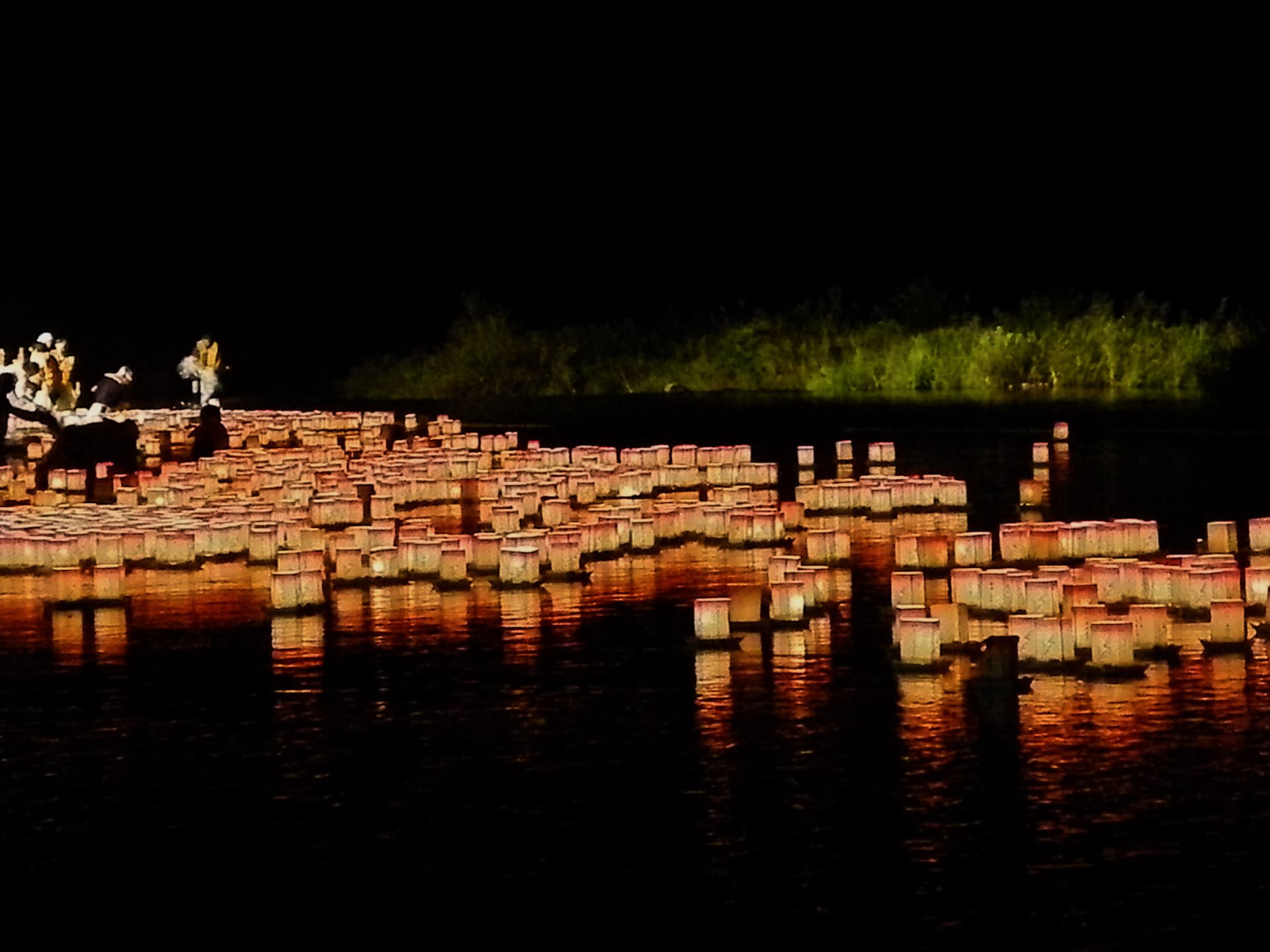
On the final evening, the direction of the season reverses. The Okuribi, the sending-off fire, is lit at the entrance of the home to guide the spirits back to their world. In many places, families float paper lanterns on rivers, lakes, or the sea in a rite called Toro Nagashi, the lanterns carrying the spirits away with the current.
The largest of the sending-off fires is the Gozan no Okuribi in Kyoto, held on the evening of 16 August. Five giant bonfires are lit in sequence on the mountains surrounding the city, burning in the shapes of written characters, a boat, and a shrine gate, each formed from stacked wood on the mountainside and visible from the streets below. The fires are understood as guiding the departing spirits on their way, and their lighting closes Obon in Kyoto. Across the country, when the fires burn down and the lanterns drift out of sight, the season ends for the year, and the ancestors are regarded as having returned to their world until the next Obon.