
Pitru Paksha at Gaya
The Hindu fortnight of rites for the ancestors
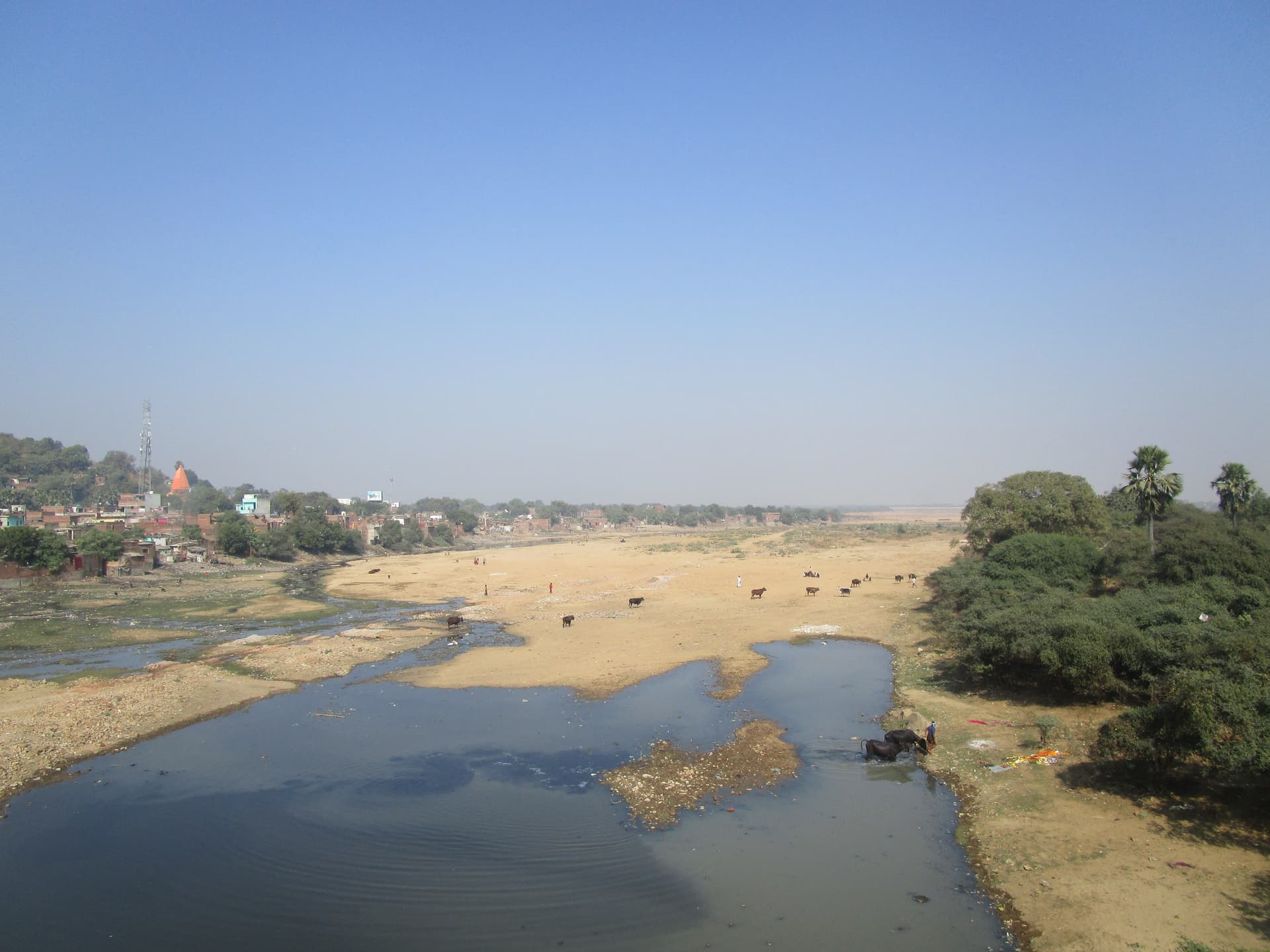
Pitru Paksha at Gaya is the annual Hindu fortnight of ancestor rites during which pilgrims travel to the city of Gaya in Bihar, India, to make offerings to their deceased forebears on the bed of the Phalgu river and at the Vishnupad Temple. Hindus regard Gaya as the principal place in India for rites on behalf of the dead, drawing pilgrims in the hundreds of thousands.
The Date of Pitru Paksha
Pitru Paksha means "the fortnight of the ancestors." It is the dark half of a lunar month in the Hindu calendar, the period during which the moon wanes from full to new. It begins the day after the full moon of the Hindu month of Bhadrapada and ends on the new moon that follows, which falls in September or October, close to the autumn equinox. The closing new moon is called Mahalaya Amavasya, the new moon of all ancestors. Hindu tradition holds that rites performed on this day reach every ancestor of the family, including those whose death dates are unknown. The gathering at Gaya runs for two full weeks.
The Ancestor Rite
The Hindu rite performed for a dead ancestor is called Shraddha (faith and devotion). It is first held in the days after a death and then repeated at intervals, most commonly on the annual death anniversary and during Pitru Paksha. The rite is traditionally the responsibility of a son, although at Gaya it is performed by men and women alike. Its purpose, in Hindu understanding, is to nourish the ancestors and to help them move from a restless state after death into the settled company of the forefathers.
The central offering is the Pinda, a ball of cooked rice, usually mixed with barley flour, sesame seeds, clarified butter and honey, formed by hand and placed on a bed of sacred grass. Each Pinda is dedicated to a named ancestor. Before the Pinda is offered, the pilgrim pours water mixed with sesame seeds from cupped hands while reciting the names of the ancestors, a rite called Tarpan, which at Gaya takes place on the sand and shallow water of the Phalgu.
Hindu tradition holds that a Shraddha completed at Gaya releases the ancestors from any further obligation on the part of their descendants. Families travel to Gaya rather than performing the rite at home.
Gayasura and the Footprint of Vishnu
The Hindu account of why Gaya is the place for ancestor rites centers on a demon named Gayasura, from whom the city takes its name. According to Hindu tradition, Gayasura undertook such severe austerities that Vishnu, the god who preserves the universe, granted him a boon: anyone who touched him would go to heaven. The realm of the dead emptied as a result, since the dead no longer needed to face judgment. The gods asked Gayasura to lend his body as the ground for a sacrifice. He agreed and lay down. The gods placed a stone on his body to hold him still, but the body kept moving, and Vishnu then pressed the stone down with his right foot.
Hindu tradition holds that Gayasura asked, as his last wish, that the place be named after him and that anyone who performed rites for the dead there would secure the ancestors' release. Vishnu granted the request and left the mark of his foot on the stone. Hindus regard the whole area covered by the demon's body as the sacred field of Gaya, and the city and its river lie within it.
Rama, Sita, and the Phalgu River
A second Hindu account connects Gaya with Rama, the prince of Ayodhya whom Hindus venerate as an incarnation of Vishnu, and his wife Sita. According to Hindu tradition, Rama came to Gaya during his years of exile to perform the Shraddha of his father. He went to gather the materials for the rite and left Sita waiting on the bank of the Phalgu. While he was away, his father's spirit appeared to Sita and asked to be fed at once. Sita had no rice, so she formed Pinda from the sand of the riverbed and offered them, with the river, a cow, a banyan tree and a priest as witnesses.
According to the same account, when Rama returned, the river, the cow and the priest denied that any rite had taken place, each hoping to receive fresh offerings when Rama repeated it. Only the banyan tree confirmed Sita's words. Sita cursed the false witnesses, and the Phalgu was condemned to flow beneath its own bed, out of sight. The banyan tree was blessed with undying life. This is the reason Hindus give for the river's condition today: outside the monsoon the Phalgu dwindles to a thin stream within a wide expanse of sand, with most of its flow moving under the surface, and pilgrims dig shallow pits in the sand to reach water for their offerings. The banyan of the account, called Akshayavat, the undying banyan, is venerated in a temple courtyard in the old city.
The Temple of Vishnu's Footprint
The temple is located on the western bank of the Phalgu in the old part of Gaya. It is built around the rock in which Hindus venerate the footprint of Vishnu. The footprint is about 40 centimeters long and is set within an octagonal basin. Pilgrims offer Pinda directly on and around it, and the temple is the most visited site of the Gaya rites.
The present temple was built in 1787 by Ahilyabai Holkar, the ruler of the state of Indore in central India. It replaced an earlier shrine on the same spot, took about a decade to build, and rises to about 30 meters. The earliest inscription referring to Vishnu's footprint at Gaya dates from the fifth century.
The Sites of the Rite
The rite at Gaya is not performed at one place but at a series of sites in and around the city. Hindu tradition counts more than three hundred of them, of which about 45 remain in regular use. They include hills around the city, bathing tanks, the riverbed itself, and the temple of the footprint. Hindu tradition also includes the Bodhi tree at the Mahabodhi Temple in Bodh Gaya, about 12 kilometers south, which Buddhists regard as the place where the Buddha, the founder of Buddhism, attained enlightenment.
The complete sequence takes seven days and ends beneath Akshayavat, where the pilgrim offers the last Pinda and makes a closing gift to the priest. The main places for the rites are the Phalgu, the temple and Akshayavat.
At Gaya the rites are conducted by hereditary priests known as Gayawals, people of Gaya. Hindus regard them as the custodians of the sites, and no rite there is complete without one. Each family of priests holds the rights to pilgrims from particular regions of India, so a pilgrim arriving from a given district is directed to the priest whose family has served that district before. The priest guides the pilgrim through the sequence, recites the required texts, and pronounces the rite complete.
- → Vishnupad Temple
- → The Calendars Behind Sacred Days. How Sun and Moon set the dates of sacred days
- → Mahabodhi Temple (Bodh Gaya)
Additional Resources
- Vishnupad Temple, Bihar Tourism
- L. P. Vidyarthi, The Sacred Complex in Hindu Gaya (Asia Publishing House, 1961)