
The Umrah
The pilgrimage to Mecca for any time of year
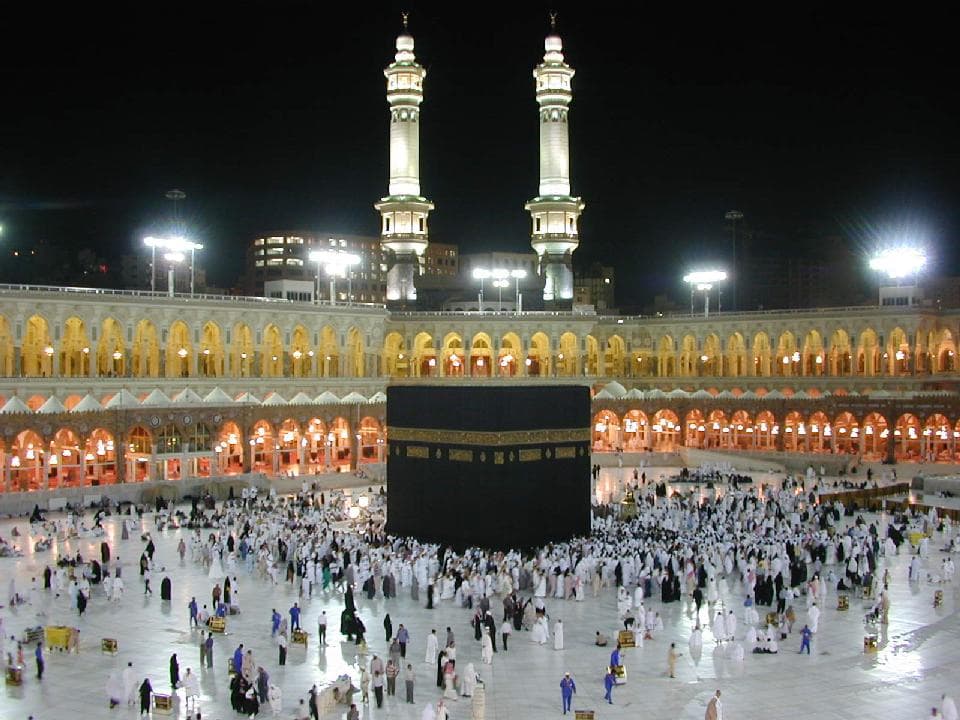
The Umrah is a Muslim pilgrimage to the city of Mecca in Saudi Arabia that can be performed at any time of the year. Muslims regard Mecca as their holiest city. The Umrah is distinct from the Hajj, the pilgrimage that every able Muslim is required to make once in a lifetime and that takes place on fixed dates of the Islamic calendar. The Umrah is voluntary, takes a few hours to complete, and is often called the lesser pilgrimage. Its rites also form part of the Hajj itself.
The State of Ihram
Pilgrims begin the Umrah by entering Ihram, a state of ritual dedication. Ihram is assumed before crossing the Miqat, one of the boundary points around Mecca defined for pilgrims arriving from different directions. Entering Ihram includes a full ritual washing, the declaration of the intention to perform the Umrah, and the repeated recitation of the Talbiyah, a prayer declaring that the pilgrim is answering God's call. While in Ihram, men wear two white unstitched cloths, women wear clothing that covers everything except the face and the hands. This uniform clothing is meant to remove all differences in order to stand before God as equal to every other pilgrim. Ihram includes a set of prohibitions, among them no perfume, no cutting of hair or nails, no intimate relations.
Tawaf
In Mecca, the pilgrim enters the Great Mosque of Mecca and performs the Tawaf, walking seven times counterclockwise around the Kaaba, the cube-shaped building at the center of the mosque. Islamic tradition holds that the Kaaba was built by the prophet Ibrahim, known in the Jewish and Christian traditions as Abraham, together with his son Ismail. Muslims all over the world face it in prayer. Each Tawaf circuit begins and ends at the corner of the Kaaba that holds the Black Stone, a stone Muslims revere as set in place by Ibrahim. Women are not allowed to perform the Tawaf during menstruation.
After the Tawaf, the pilgrim prays two units of prayer near the Maqam Ibrahim, a station in the mosque that Muslims associate with the place where Ibrahim stood during the building of the Kaaba.
Sa'i and the Well of Zamzam
The pilgrim then performs the Sa'i, walking seven times between Safa and Marwa, two small hills now enclosed within the mosque. The ritual goes back to an account of Hajar (Hagar), the wife of Ibrahim. Islamic tradition holds that Ibrahim left Hajar and their infant son Ismail alone in the barren valley of Mecca at God's command. When their water was gone, Hajar climbed Safa, then Marwa, and crossed between the two hills seven times, looking for water or a passing traveler. Water then broke through the ground at the feet of her son, and this spring became the Well of Zamzam. The well is located within the mosque complex today, and pilgrims drink its water during their stay in Mecca.
Completing the Umrah
The Umrah ends with the cutting of hair. Men shave the head (Halq) or shorten the hair evenly (Taqsir). Women cut a small length from the ends of their hair, about the width of a fingertip. With this act the pilgrim leaves the state of Ihram, and its restrictions end.
The Timing of the Umrah
The Umrah can be performed on any day of the year. Islamic tradition holds that an Umrah performed during Ramadan, the month of fasting, carries a reward equal to that of a Hajj. Millions of Muslims perform the Umrah each year, and for many it is the journey that brings them to Mecca for the first time.
- → The Hajj. A five-day pilgrimage to Mecca at the heart of Islam
- → The Calendars Behind Sacred Days. How Sun and Moon set the dates of sacred days
- → Great Mosque of Mecca
Additional Resources
- Venetia Porter (ed.), Hajj: Journey to the Heart of Islam (British Museum Press, 2012)