
Ashura at Karbala
The day of mourning for Husayn at his shrine
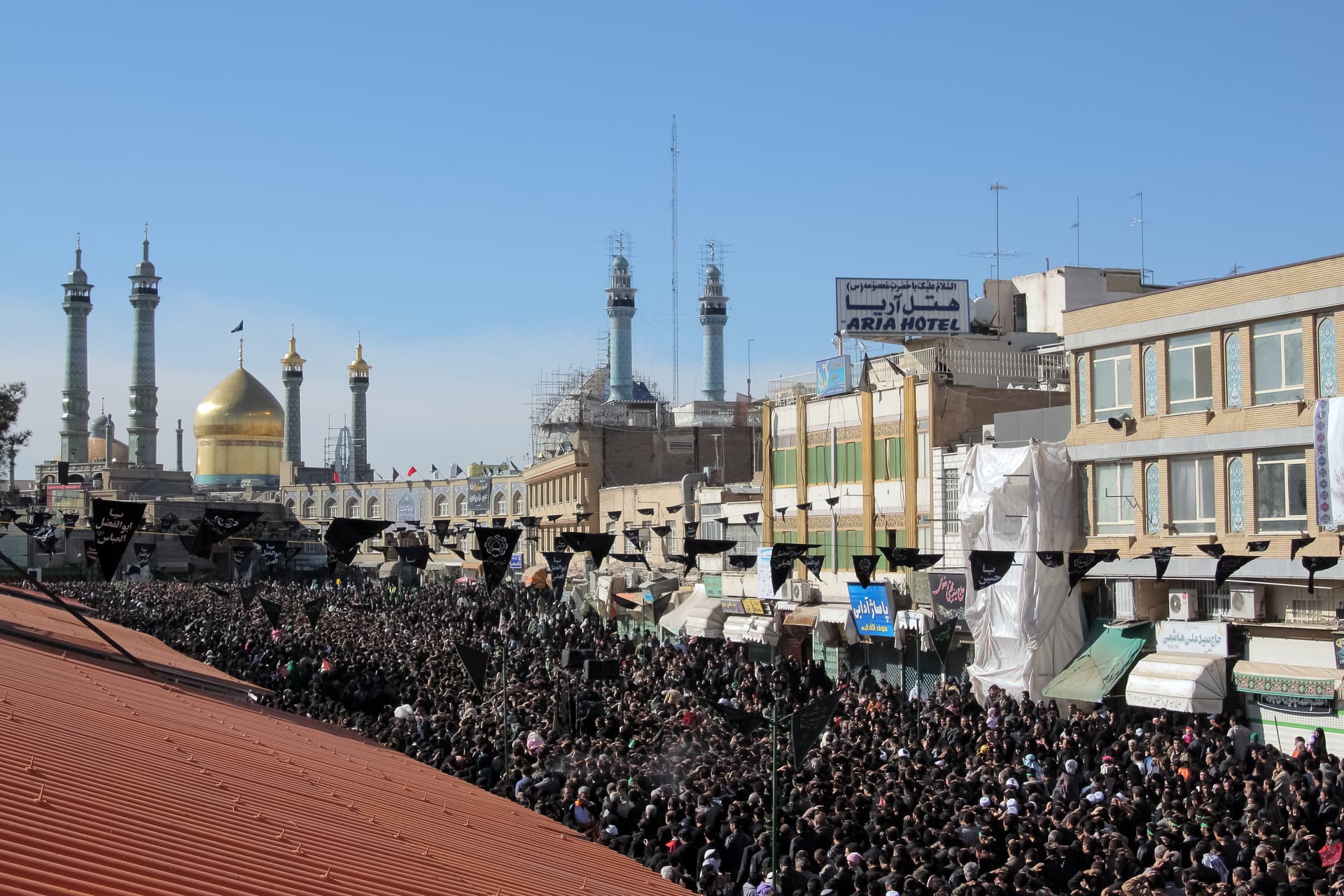
Ashura is the tenth day of Muharram, the first month of the Islamic calendar, and the day on which Shia Muslims mourn the death of Husayn ibn Ali at Karbala in 680 CE. Husayn was the grandson of the Prophet Muhammad and, in Shia Islam, the third Imam, one of the divinely guided leaders of the community after the Prophet. His tomb at Karbala, in present-day Iraq, is the Imam Husayn Shrine, and the city around it is among the holiest places in Shia Islam. On Ashura, millions of mourners gather in Karbala, and the shrine becomes the center of the commemoration of Husayn's death. Because the Islamic calendar follows the moon, Ashura moves about eleven days earlier each year against the civil calendar.
About Husayn and the Events of Karbala
Husayn was born in Medina, the son of Ali, the Prophet's cousin and son-in-law, and of Fatima, the Prophet's daughter. In 680 CE the caliph Muawiya died and his son Yazid took the caliphate, the leadership of the Muslim community. Husayn refused to give Yazid his allegiance. He left Mecca with his family and a small group of companions and traveled toward the city of Kufa in Iraq, whose people had written to invite him. An army sent by the governor of Kufa stopped the party on the plain of Karbala, about seventy kilometers north of the city, and cut it off from the Euphrates river.
Shia tradition holds that Husayn and his companions were denied water for days before the battle. On the tenth of Muharram the army attacked. Husayn's companions, by tradition seventy-two of them, were killed one after another, and Husayn was killed last. The women and children of his family, among them his sister Zaynab and his son Ali, were taken captive to Kufa and then to the caliph's court in Damascus. Shia Muslims hold that Husayn chose death rather than give legitimacy to an unjust ruler, and they regard his stand as the defining act of their faith.
Sunni Islam tradition holds that on the tenth of Muharram God delivered Moses and the Israelites from Pharaoh, and that the Prophet Muhammad recommended fasting on that day in thanksgiving. Sunni Muslims keep Ashura as a day of voluntary fasting. They honor Husayn as the grandson of the Prophet.
The Shrine and the City
Husayn's grave is at the place of the battle. The Imam Husayn Shrine was built over it and has been destroyed and rebuilt several times since the seventh century. Today it is a large complex at the center of Karbala with a gold-covered dome and minarets, and the tomb lies within an enclosure of silver and gold. Shia Muslims regard a visit to the tomb as an act of devotion that earns merit and brings the visitor close to Husayn, who they hold will intercede for them on the Day of Judgment. A few hundred meters away is the shrine of Abbas, Husayn's half-brother, who was killed at Karbala while trying to bring water to the camp, and whom Shia Muslims honor for his loyalty. The open ground between the two shrines is where the largest gatherings of the mourning season take place.
The Mourning of Muharram
The mourning begins on the first of Muharram and reaches its height on Ashura. Shia Muslims understand the ten days as a time to relive the events of Karbala and to share in Husayn's suffering. Each evening communities gather in mosques, in halls built for the purpose, and in private homes, where a speaker recounts the events of Karbala day by day and elegies are sung. The listeners weep and beat their chests in rhythm. Shia tradition holds that grief for Husayn is itself an act of faith, and that tears shed for him are rewarded by God. Black clothing is worn for the ten days as a sign of mourning, and black cloth is hung on the shrines, on houses, and across streets. Processions with banners and standards recall Husayn's camp and the companions who died with him. The gatherings take place wherever Shia Muslims live, in Iraq, Iran, Lebanon, the Gulf, South Asia, and the diaspora, and in Karbala the streets around the shrines fill with mourners from Iraq and abroad during the ten days.
The ninth of Muharram is kept as the night of the final vigil, on which Shia tradition holds that Husayn and his companions spent their last night in prayer.
The Day of Ashura in Karbala
On the morning of Ashura, mourners fill the shrine of Husayn, the shrine of Abbas, and the ground between them. The account of the battle is recited in full at the shrine, so that those present follow the events of the day hour by hour. Processions with standards, black banners, and drums move through the city. Chest-beating and the recitation of elegies continue through the day. Some mourners strike themselves with chains or cut themselves as a sign of grief; most Shia religious authorities in Iraq discourage the drawing of blood and encourage the donation of blood instead.
In the early afternoon, at the hour at which tradition places Husayn's death, the Tuwairij run takes place. Tens of thousands of men run from the eastern edge of the city to the shrine of Husayn, beating their chests as they go, while the women walk behind. It is said that the run recalls the people of the Tuwairij district who hurried to help Husayn when they heard of the battle and arrived too late; the runners repeat their haste as an act of loyalty to Husayn. The run ends at the shrine, where the crowd gathers in mourning. Across Iraq and Iran, Ashura afternoon is also the time of the mourning play, a reenactment of the battle performed in open spaces so that the community sees the events it has heard recited.
Food is cooked in great quantities and given freely to mourners and passers-by throughout the ten days and above all on Ashura. Shia Muslims make these offerings in fulfillment of vows made in Husayn's name and as a share in the hospitality that Husayn's camp was denied.
Arba'een and the Visit to the Tomb
Forty days after Ashura, on the twentieth of the following month, Safar, Shia Muslims mark Arba'een, the fortieth day of mourning. Millions walk to Karbala from across Iraq for it. Shia tradition holds that mourning for Husayn carries merit in the afterlife, and that his sacrifice protects the faith from corruption by unjust rulers. The visit to his tomb, on Ashura, at Arba'een, or at any other time of the year, is one of the central acts of Shia devotion.
- → The Calendars Behind Sacred Days. How Sun and Moon set the dates of sacred days
- → Imam Husayn Shrine
- → Arba'een. The pilgrimage of millions to Karbala
Additional Resources
- Imam Hussain Holy Shrine, official site
- Hamid Dabashi, Shi'ism: A Religion of Protest (Harvard University Press, 2011)