
Chhath Puja
The Hindu festival of the Sun at the riverbanks of Bihar
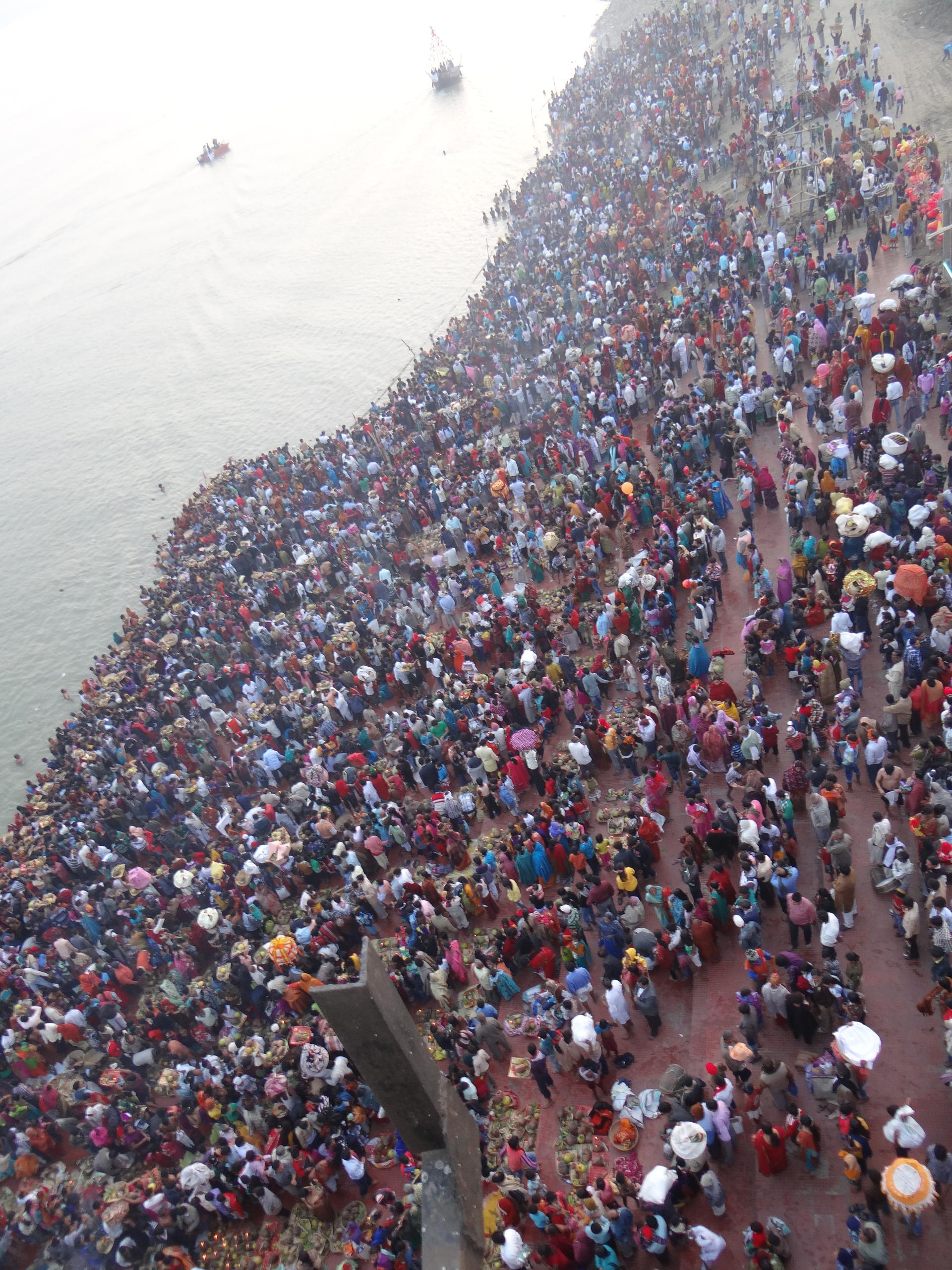
Chhath Puja is a Hindu festival in which devotees worship Surya, the Sun, and the goddess Chhathi Maiya. They stand in rivers and ponds to make offerings to the setting and the rising sun. The festival is held over four days in the month of Kartik in the lunisolar calendar, in October or November. Its main day, the evening of the offering to the setting sun, falls on the sixth day after the new moon, six days after Diwali, the festival of lamps. The name comes from the Sanskrit word for "sixth". A smaller Chhath is held in spring, in the month of Chaitra, in March or April. The festival is celebrated above all in the states of Bihar and Jharkhand, east of India, and in the east of Uttar Pradesh, north of India, and in the Terai, the southern plains of Nepal. Families from these regions celebrate it wherever they live, in the cities of India and in Mauritius, Fiji, Trinidad and Tobago, the United Kingdom, and the United States. Millions of devotees take part. In Bihar the banks of the River Ganges (Ganga), which Hindus revere as a goddess and a purifying river, are the principal places of worship.
About Surya and Chhathi Maiya
Hindus worship Surya as the god who gives light, warmth, and life to the world. Through the festival Chhath devotees thank him for life, health, and the harvest of the past year. They pray for the well-being of their families, for children, and for the healing of the sick.
Chhathi Maiya, Mother Chhathi, is the goddess of the festival. Devotees pray to her above all for children and for their protection. Accounts of where she belongs among the gods and goddesses differ from region to region and from family to family, and she does not appear in the classical Hindu texts. Many identify her with Shashthi, a goddess who, according to Hindu tradition, protects children in the first days of their lives. Others know her as Usha, the dawn, the wife of Surya, or as the sister of Surya.
One account explains why the setting sun is worshiped as well as the rising sun. According to this account, Surya has two wives: Usha, the first light of the morning, and Pratyusha, the last light of the evening. Devotees honor Pratyusha with the offering at sunset and Usha with the offering at dawn.
The Origins of Chhath Puja
Hindu tradition connects the festival with figures from the two great epics of Hinduism. According to one account in the tradition of the Ramayana, the epic of the god Rama, Rama and his wife Sita worshiped the Sun in this way after their return to their city of Ayodhya from fourteen years of exile. The Mahabharata is the epic of a war between two branches of a royal family. Five brothers, the Pandavas, are the princes of one branch, and in the epic they lose their kingdom to their cousins of the other branch. Accounts in the tradition of the Mahabharata tell that Draupadi, the queen of the five brothers, prayed to the Sun for the restoration of their kingdom. Popular tradition also connects the festival with Karna, a hero of the same epic whom Hindu tradition regards as a son of Surya and who worshiped the Sun every day.
Chhath is performed without priests. The rites are passed down within families, above all from women to women, through songs sung in Bhojpuri, Maithili, and the other languages of the region.
The Four Days of Chhath Puja
The fast is kept by one member of the family on behalf of all, in most cases a woman. Many take it on to fulfill a vow made for a child, for the cure of an illness, or in thanks for a wish that was granted, and many keep it every year for the rest of their lives. When a devotee can no longer keep the fast, another member of the family takes it over. Everything in the festival is governed by rules of purity, since the offerings are made to a god. Food is cooked without onion, garlic, or salt, often on clay stoves, and the offerings are carried in baskets of bamboo and lit with lamps of clay.
On the first day, the fourth day after the new moon, the house is cleaned and the devotees bathe in a river or pond. They then eat a single pure meal, usually rice with lentils and bottle gourd. The meal marks the beginning of the state of purity in which they will keep the fast.
The second day is called Kharna. The devotees fast through the day, without food and water. After sunset they cook a pudding of rice and jaggery, unrefined cane sugar, with flatbread, offer it first to the goddess, and then eat it, usually in silence. It is their last meal until the end of the festival. The fast that follows lasts about one or two days, without food and without water. On this evening women sing songs to call the goddess to the riverbank.
On the third day, in the afternoon, families walk to the river or pond in procession, carrying the offerings on their heads in bamboo baskets. Women sing the songs of Chhath along the way. At the water's edge each family has marked out its place with a small altar of earth. Shortly before sunset the devotees walk into the water up to the waist and stand facing the sun. They raise winnowing baskets of bamboo filled with fruit of the season, coconuts, sugarcane, and thekua, a sweet of wheat flour and jaggery baked for the festival, and offer them to the setting sun, while family members pour water or milk before them. That night, in many homes, families whose wish has been granted set up a canopy of sugarcane stalks around clay lamps in the courtyard, as a thanksgiving to the goddess.
On the fourth day the families return to the water before dawn and stand waiting in the dark. When the sun rises, the devotees make the same offering to the rising sun. With this the festival is complete. The devotees break their fast at home, and the blessed food from the offerings is shared with family, neighbors, and everyone who asks for it.
Chhath Puja on the Ganges
In Bihar the festival centers on the banks of the River Ganges (Ganga). In Patna, the capital city of the state of Bihar, which is located on the southern bank of the river, the ghats, the stone steps and banks leading down to the water, are cleaned and prepared for the festival, and hundreds of thousands of devotees stand in the river at sunset and at dawn. Bathing in the Ganges is itself a purifying act for Hindus, and for families who live along the river the offering in its water joins the worship of the Sun with the worship of the river goddess.
In locations where there is no river, devotees use ponds and lakes, and in many towns temporary pools are dug for the festival. In Delhi, families from Bihar and eastern Uttar Pradesh gather on the banks of the Yamuna, a river Hindus also revere as a goddess. In the Terai of Nepal, the town of Janakpur, which Hindu tradition regards as the birthplace of Sita, cleans its sacred ponds each year for the offerings.
- → The Calendars Behind Sacred Days. How Sun and Moon set the dates of sacred days
- → Diwali. The festival of lamps of Hindus, Jains, and Sikhs
- → River Ganges (Ganga)