
Diwali
The festival of lamps of Hindus, Jains, and Sikhs
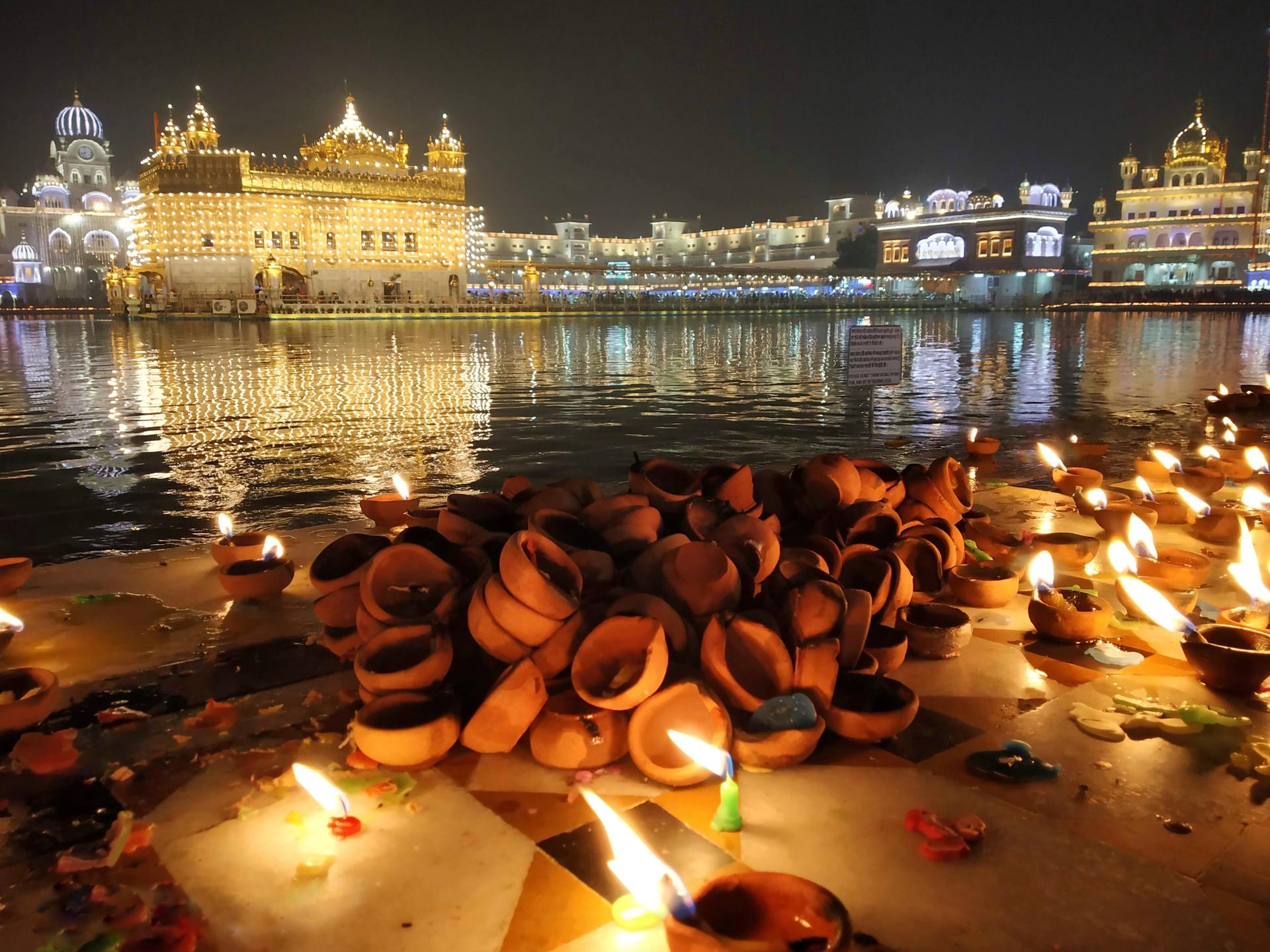
Diwali is the festival of lamps, celebrated by Hindus, Jains, and Sikhs over several days around the new moon of the month of Kartik in the lunisolar calendar, in October or November. Its name comes from the Sanskrit word Deepavali, a row of lamps. On the night of the new moon, the darkest night of the month, families light rows of small oil lamps in their homes, in temples, and along rivers and streets. Hindus understand the light as the victory of light over darkness, of good over evil, and of knowledge over ignorance. Each tradition connects the night with its own account. For many Hindus it is the night the god Rama returned to his city of Ayodhya, and the night the goddess Lakshmi visits the home. For Jains it is the night their last great teacher, Mahavira, was freed from rebirth. For Sikhs it is the day their sixth Guru, one of the ten teachers who led the Sikh community, returned to Amritsar after his release from captivity. Hundreds of millions of people celebrate the festival in South Asia and around the world.
The Accounts Behind Diwali
In North India, Diwali celebrates the return of Rama to Ayodhya. Hindus worship Rama as a form of Vishnu, the god who preserves the world, and his life is told in the Ramayana, one of the two great epics of Hinduism. Hindu tradition holds that Rama was sent into exile in the forest for fourteen years, together with his wife Sita and his brother Lakshmana. During the exile Ravana, a demon king, abducted Sita, and Rama defeated him in battle and freed her. When Rama, Sita, and Lakshmana came home to Ayodhya on the new moon of Kartik, the people lit lamps along the streets to welcome them. The lamps of Diwali repeat that welcome every year.
In South India the festival is connected above all with the defeat of Narakasura, a demon who, according to Hindu tradition, had taken thousands of women captive. The god Krishna, another form of Vishnu, and his wife Satyabhama defeated him on the day before the new moon and freed the women. In much of South India that day is the main day of the festival. It begins with a ritual bath with oil before dawn, which repeats the bath that Hindu tradition holds Krishna took after the battle.
On the night of the new moon Hindus across India worship Lakshmi, the goddess of wealth and good fortune and the wife of Vishnu. Hindus believe that Lakshmi visits homes that are clean and lit on this night and brings blessings for the coming year. She is worshiped together with Ganesha, the elephant-headed god who removes obstacles, so that wealth comes with wisdom. In Bengal, in eastern India, the same night is devoted to the goddess Kali, a fierce form of the Goddess who destroys evil.
The Days of Diwali
Diwali lasts five days in most of India, and six in some regions. Each day has its own purpose.
Diwali in Hinduism
In the days before the festival, families clean and repair their homes, since Lakshmi is held to enter only a clean house. On the first day many buy gold or new household items. Hindus regard the day as auspicious for wealth and health, and Hindu tradition connects it with Dhanvantari, the physician of the gods, who rose from the ocean holding a pot of the nectar of immortality. Lamps are lit at the doorway that evening.
The second day recalls the defeat of Narakasura and the bath that followed it. In Bengal, lamps are lit that evening for the ancestors of the family.
The third day, the night of the new moon, is the center of the festival. Families draw patterns called rangoli on the floor at the entrance of the house, with colored powder, rice flour, or flower petals, to welcome good fortune and the goddess. In the evening they worship Lakshmi and Ganesha at a home shrine and then light lamps in every room, on windowsills, and on the roof, so that no corner of the house is left dark. Many set off fireworks. Merchants, especially in western India, bless their new account books on this night and open the financial year with the goddess's blessing.
The fourth day recalls another act of Krishna. According to Hindu tradition, Indra, the king of the gods, sent storms against Krishna's village because its people had stopped making offerings to him, and Krishna lifted Govardhan, a hill near his home, and held it over the villagers like an umbrella for seven days to shelter them. Temples prepare a mountain of food for Krishna in memory of the hill and then share it among the worshipers. In Gujarat, in western India, this day is New Year's Day.
The fifth day honors the bond between brothers and sisters. Hindu tradition holds that Yama, the god of death, visited his sister Yamuna, the goddess of the river of the same name, on this day, and that she welcomed him with a mark on his forehead and a meal. In return he promised a long life to every brother who receives his sister's blessing on this day. Sisters mark their brothers' foreheads and pray for their long life, and brothers give them gifts.
In Nepal the festival (called "Tihar") is celebrated over five days. On the first three days people honor crows, as the messengers of Yama, dogs, as the guardians of the home, and cows, as a form of Lakshmi. The worship of Lakshmi and the blessing of brothers by their sisters follow.
Diwali in Jainism
Jains celebrate Diwali as the night on which Mahavira, the twenty-fourth and last of the Tirthankaras, the great teachers of Jainism who showed the way to liberation, was freed from the cycle of rebirth. According to Jain tradition this took place at Pavapuri, in the present-day state of Bihar, in 527 BCE. Jain tradition holds that the kings who were present lit lamps to replace the light of his knowledge, which had left the world. Jains spend the night in prayer and fasting. The next morning, the first day of the Jain new year, they celebrate the enlightenment of Gautama, Mahavira's chief disciple, which Jain tradition holds he attained in the same night.
Diwali in Sikhism
Sikhs celebrate Diwali as Bandi Chhor Divas, the day of release from captivity. Sikh tradition holds that the sixth Guru, Guru Hargobind, was held captive in the fort of Gwalior by the Mughal emperor Jahangir in the early 17th century. When he was granted his release, he refused to leave unless fifty-two imprisoned rulers were freed with him. He was permitted to take with him as many as could hold on to his cloak, and he had a cloak made with fifty-two strings, so that all of them walked out holding on to it. For this Sikhs call him the Deliverer of Prisoners. When he returned to Amritsar at Diwali, the city was lit to welcome him.
The Sri Harmandir Sahib (Golden Temple) in Amritsar, the principal gurdwara (Sikh place of worship) of Sikhism, is lit with lamps on this night, and fireworks are set off over its sacred pool. In the 18th century, when the Mughal governors of the Punjab persecuted the Sikhs, they gathered at Amritsar for Diwali despite the danger.
Diwali on the Rivers of North India
Along the rivers of North India the lamps are set out on the ghats, the stone steps leading down to the water. In Ayodhya, the city of Rama, the government of the state of Uttar Pradesh holds a festival of lamps on the banks of the Sarayu river each year at Diwali, in which millions of oil lamps are lit in memory of Rama's return.
In Varanasi (Kashi), the city that Hindus regard as the city of the god Shiva, the festival of lamps has a second night. Fifteen days after Diwali, on the full moon of Kartik, the city celebrates Dev Deepawali, the Diwali of the gods. Hindu tradition holds that on this night the gods come down to earth to bathe in the River Ganges (Ganga), which Hindus revere as a goddess and a purifying river, and to celebrate the victory of Shiva over the demons of Tripura, three cities that he destroyed with a single arrow. Lamps are lit along the full length of the ghats of Varanasi to welcome the gods.
- → The Calendars Behind Sacred Days. How Sun and Moon set the dates of sacred days
- → Sri Harmandir Sahib (Golden Temple)
- → Varanasi (Kashi)
- → River Ganges (Ganga)
- → Chhath Puja. The Hindu festival of the Sun at the riverbanks of Bihar