The Days of Awe
From Rosh Hashanah through Yom Kippur to Sukkot
The Days of Awe are the most solemn period of the Jewish year: the ten days that begin with Rosh Hashanah, the Jewish New Year, and end with Yom Kippur, the Day of Atonement. In Hebrew the period is called the Yamim Noraim. It falls in Tishrei, the month of the Jewish calendar that begins in September or October. Jewish tradition holds that during these days God reviews the deeds of every person and decides their fate for the coming year, and that repentance, prayer, and charity can change the decision before it is sealed. Five days after Yom Kippur, the same month brings Sukkot, a seven-day festival of thanksgiving, so that the season moves from self-examination to joy within a few weeks.
Rosh Hashanah
Rosh Hashanah, the Jewish New Year, begins on the first day of Tishrei and is traditionally celebrated for two days. Jewish tradition holds that it marks the anniversary of the creation of the world and the day on which God begins to judge it. The central ritual is the sounding of the Shofar, a ram's horn, blown in the synagogue in a series of prescribed calls. Jewish teaching describes the sound as a call to wake up and examine one's life.
At home, the holiday is marked with festive meals. Apples are dipped in honey, and bread is baked in round loaves, for the wish of a sweet and complete year. A common greeting of the season expresses the hope to be inscribed in the Book of Life, the record in which, according to Jewish tradition, God writes each person's fate on Rosh Hashanah and seals it on Yom Kippur. In the afternoon, many communities hold Tashlich, a short prayer beside a river, a lake, or the sea, during which people symbolically cast their sins into the water.
The Ten Days of Repentance
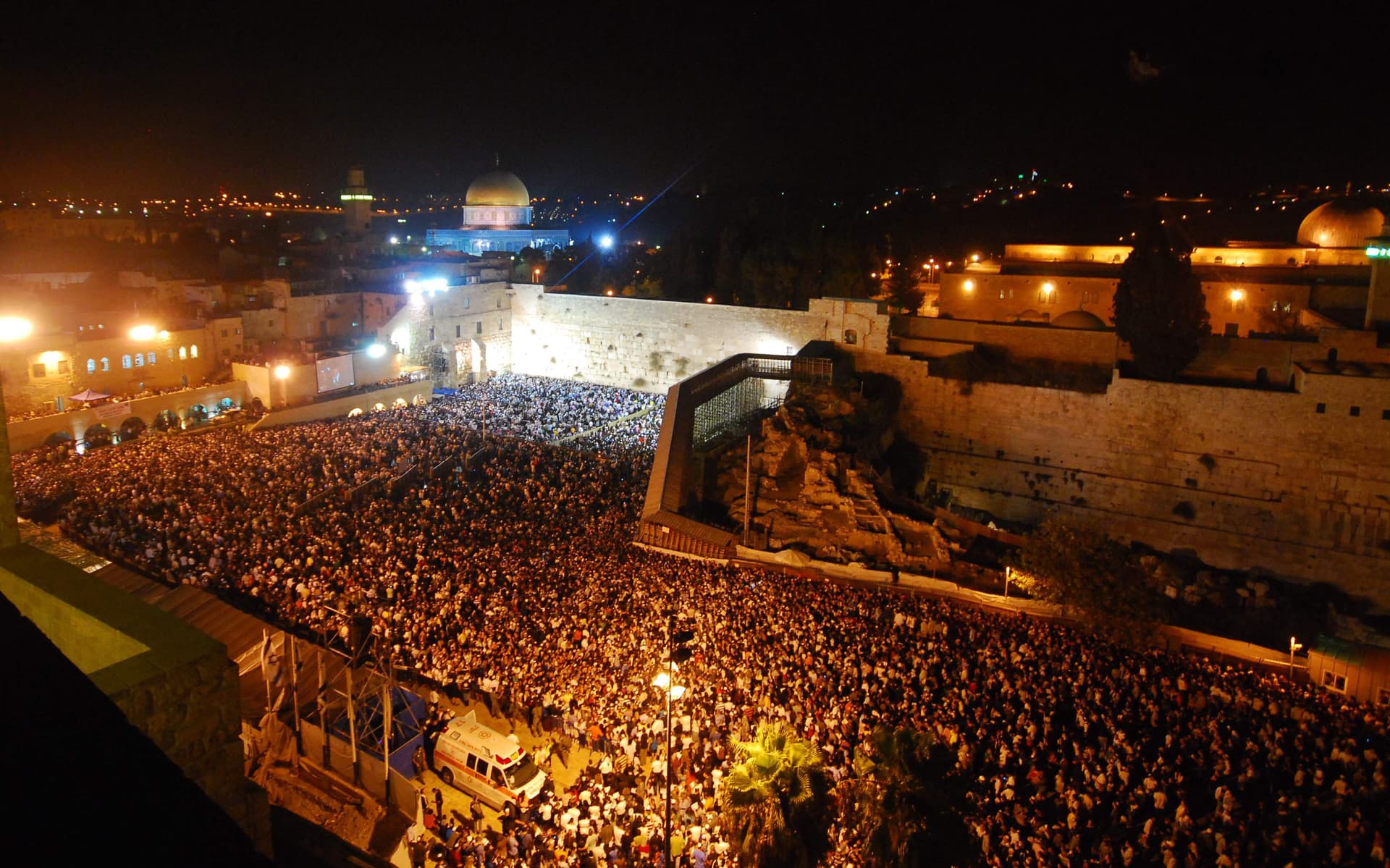
The days from Rosh Hashanah to Yom Kippur are called the Ten Days of Repentance. The Hebrew word for repentance, Teshuvah, literally means return. Jewish teaching holds that Yom Kippur brings forgiveness only for wrongs against God, and that wrongs against another person must be put right with that person directly. These days are therefore a time for apologizing, settling disputes, repaying debts, and giving to charity. In the weeks around the Days of Awe, penitential prayers called Selichot are recited before dawn or late at night, and in Jerusalem tens of thousands of people gather for these prayers at the Western Wall.
Yom Kippur
Yom Kippur, the Day of Atonement, falls on the tenth of Tishrei. Jews regard it as the holiest day of the year. For about twenty-five hours, from before sunset until nightfall the next day, adults in good health fast completely, taking no food and no water. Work stops, and in Israel public life largely comes to a standstill. Many wear white as a sign of purity. The day opens with Kol Nidrei, an evening service named after a formal declaration concerning the annulment of certain personal religious vows made to God. The declaration does not release anyone from obligations to other people. Much of the following day is spent in the synagogue in a cycle of services devoted to confession and atonement. The day closes with Neilah, the final service, and a last long blast of the Shofar. Jewish tradition holds that at this moment the Book of Life is sealed.
Sukkot
Five days after Yom Kippur, on the fifteenth of Tishrei, Sukkot begins. The name means booths or huts, and the festival lasts seven days. Families build a Sukkah, a temporary shelter roofed with branches and leaves, made to give shade and ideally still open enough for the stars to be seen at night. They eat their meals in it for the week, and some also sleep there. Jewish tradition holds that the Sukkah recalls the temporary shelters in which the Israelites lived during their forty years in the desert after the exodus from Egypt, the departure from slavery that the Hebrew Bible recounts.
The other central ritual of Sukkot is the taking of the Four Species: a citron fruit called the Etrog, and a palm branch called the Lulav bound together with myrtle and willow branches. During prayers they are held together and waved toward the four directions, upward and downward. Jewish tradition calls Sukkot the season of joy, and its mood is the counterpart to the solemnity of the Days of Awe. Sukkot is followed immediately by two connected holidays, Shemini Atzeret and Simchat Torah, which close the festival season. In Israel the two fall on the same day, and in many communities outside Israel Simchat Torah is celebrated on the following day. On Simchat Torah the yearly cycle of reading the Torah, the five books of Moses, is completed and begun again, celebrated with processions and dancing with the Torah scrolls.
- → The Calendars Behind Sacred Days. How Sun and Moon set the dates of sacred days
- → Western Wall
- → Rosh Hashanah in Uman. At the grave of Rebbe Nachman of Breslov
Additional Resources
- S.Y. Agnon, Days of Awe: A Treasury of Jewish Wisdom for Reflection, Repentance, and Renewal on the High Holy Days (Schocken Books, 1995)